
Choose the Mortar by the Assembly, Not the Modifier
Tile thinset, adhered-veneer, paving and ASTM C270 unit-masonry mortars are different categories. How to match ANSI and ASTM designations to the actual job.
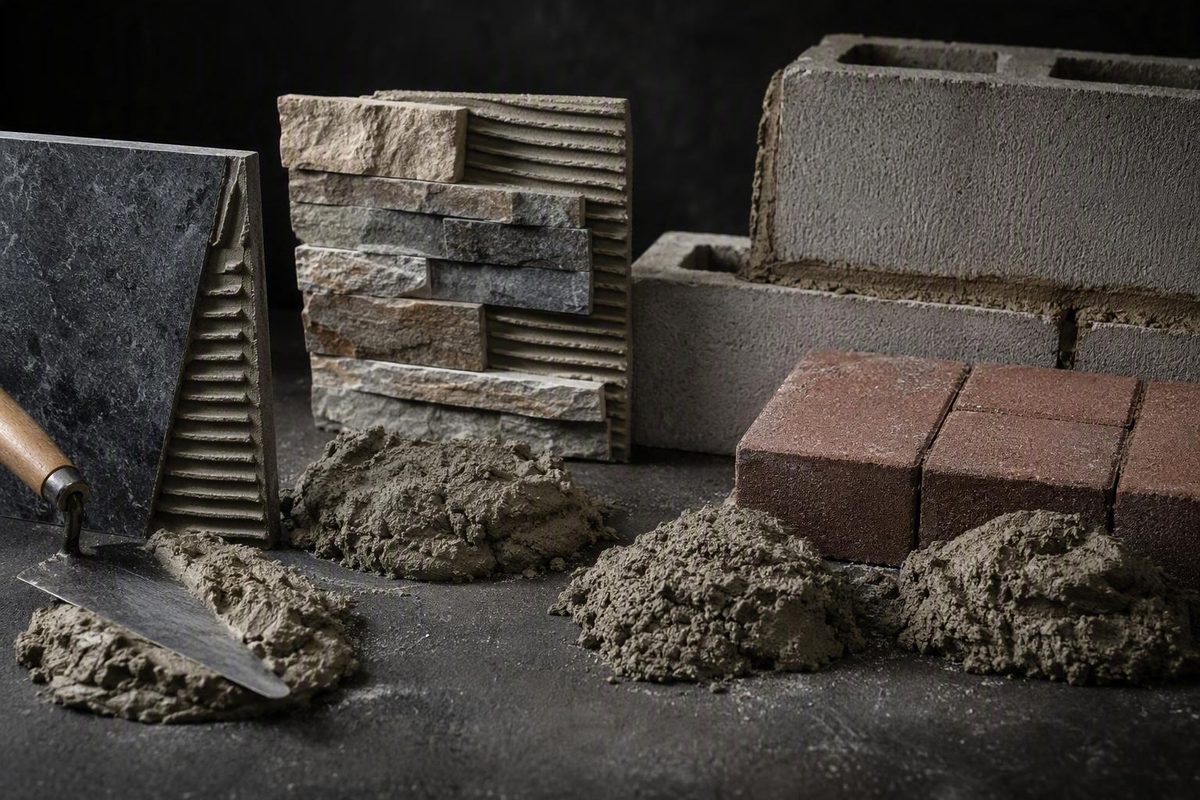
“Polymer modified” names an ingredient, not a specification. The mortar you need is set by the assembly. Tile takes a thinset carrying the ANSI A118.4 or A118.15 designation the spec calls for. Adhered thin brick or stone takes a purpose-made adhered-veneer mortar. Brick paving takes the paving mortar the detail names, where modified dry-set mortar or Type S with an approved liquid polymer additive is one option in certain assemblies. Full-depth brick or CMU takes an ASTM C270 Type M, S, N or O unit-masonry mortar. Across the manufacturer and trade literature reviewed here, improved adhesive bond is the only benefit documented consistently. Open time, sag resistance, deformability, immersion and freeze-thaw suitability belong to named formulations under their own test designations, and the label on the bag proves none of them.
Pick the application, substrate and exposure; the category, designation and verification list update beside the controls.
Mortar category, designation and what to verify
Substrate and exposure statuses are screened against the cited MAPEI tile-mortar sheets and apply to tile work only.
Cured concrete, masonry, brick, mortar beds and cement backer units appear on the cited sheets. Confirm cure, preparation, flatness and bond-coat limits.
- Tile type, size, backing and moisture sensitivity (resin-backed and moisture-sensitive stone are excluded from the cited cementitious mortars)
- Bond-coat thickness range and mortar contact on the product sheet
- Mortar named at each membrane interface, above and below
- Movement joints carried through the tile, never filled with mortar
Sources: MAPEI Ultraflex 2 and Ultralite Mortar Pro data sheets, TEC standards overview, BIA Technical Note 8B, Schluter DITRA-HEAT handbook (Oct 2025). Product figures apply to the named products only.
Which Mortar Category the Job Requires
| Application | Mortar category | Selection basis |
|---|---|---|
| Tile | Tile-setting thinset | Required ANSI classification, tile, substrate, exposure, assembly |
| Adhered thin brick or stone | Purpose-made adhered-veneer mortar | Veneer system, substrate, exposure, project requirements |
| Brick paving | Paving mortar named by the assembly | Paving detail, exposure, base, joints, specification |
| Full-depth brick or CMU | Unit-masonry mortar | ASTM C270 type, structural role, units, exposure |
Tile thinset is a bond coat, not bed-joint mortar. Start with the ANSI designation the specification and the complete assembly require; the modifier is one part of that classification. Tile type, substrate, bond-coat thickness, location, membrane requirements and service exposure remain the controlling variables.
For adhered thin brick, manufactured stone, or natural thin-cut stone, look for a mortar sold for that purpose. One retailer listing describes SPEC MIX Polymer Modified Adhered Veneer Mortar as a bonding mortar for those finishes over cementitious substrates. That intended-use line separates the category from tile thinset and conventional masonry mortar, but it is not a system specification and does not transfer to other products or substrates. See the retailer’s stated application.
Brick paving is its own case. Brick Industry Association guidance recognizes modified dry-set mortar and Type S mortar mixed with an approved liquid polymer additive as options in certain paving assemblies. The same guidance places Types M, S, N and O in the unit-masonry selection framework, weighted by application, exposure, unit properties and project requirements, and it does not treat tile thinset as general-purpose mortar for structural brickwork. Review the BIA mortar-selection guidance.
For full-depth brick and concrete masonry units, especially load-bearing work, select under ASTM C270 and the contract documents, subject to the structural and code requirements that apply. Types M, S, N, and O are unit-masonry mortar classifications, not alternative grades of tile thinset. BIA recommends the lowest-compressive-strength type that still meets project requirements, because bond, durability, moisture resistance, workability and unit properties count alongside compressive strength.
One rule governs all four categories: polymer modification does not by itself establish structural use, waterproofing, immersion suitability, freeze-thaw suitability or compatibility with any particular substrate.
What Polymer Modification Changes and What It Does Not
In tile-setting mortar the polymer arrives one of two ways. Powdered polymer is blended at the factory and activated when the bag is mixed with water, or a compatible liquid polymer additive is combined with a dry-set mortar as directed, sometimes in place of the mixing water.
Portland cement hydration still builds the matrix. In one manufacturer’s explanation, the cement reaction consumes mix water while the polymer particles coalesce into an adhesive film that improves bonding to relatively impervious surfaces; the same bulletin notes that strength development can be slower in a relatively sealed assembly. That is an account of the materials it covers, not a curing schedule for every modified mortar. Read the technical explanation.
Every other property has to be tied to a named formulation and its test designations. Extended open time is how long a spread mortar meets the applicable workability requirement. Sag resistance concerns vertical placement. Large-and-heavy-tile capability concerns holding the permitted bond coat under bigger or heavier units. Fast set identifies accelerated setting. Deformability is a tested response of the adhesive, not permission to skip movement joints.
MAPEI, for instance, reports ISO S1 deformability for Ultralite Mortar Pro and describes it as suitable for large-and-heavy-tile and nonsag work, with a stated bond-coat range and ANSI classifications on the data sheet. Those properties belong to that formulation under its stated methods and conditions, not to every polymer-modified bag on the shelf. See the Ultralite Mortar Pro technical data.
Decode the ANSI and ASTM Designations Before Comparing Products
The table summarizes how the cited manufacturer and technical sources use these designations. It does not reproduce the official standards or establish which edition a given project has adopted.
| Designation | Category | What it does not prove |
|---|---|---|
| ANSI A118.1 | Unmodified dry-set tile mortar | Compatibility with every tile, membrane, substrate or exposure |
| ANSI A118.4 | Modified dry-set cement mortar | Structural masonry use, waterproofing, universal exterior suitability |
| ANSI A118.15 | Improved modified dry-set cement mortar | That it is automatically right for every assembly |
| ANSI A118.11 | Latex-Portland cement mortar for exterior-glue plywood | Approval for OSB, every plywood assembly, wet service or exterior wood |
| ASTM C270 Types M, S, N, O | Mortar for unit masonry | Tile-setting performance or equivalence to any ANSI thinset category |
TEC’s overview associates A118.4 and A118.15 with modified tile-setting mortars and describes A118.15 as imposing stricter requirements than A118.4. It also lists the common suffixes: E for extended open time, T for sag resistance, H for large and heavy tile, F for fast set. They are useful for screening; the complete assembly decides which of them you need. See TEC’s standards summary.
A118.11 deserves the most caution. A bag carrying it is a candidate for a qualifying plywood installation, but approval still depends on plywood grade, framing, layer configuration, fastening, location, exposure and product restrictions. It does not establish permission to bond to OSB.
ASTM C270 sits on a different branch. A construction-materials engineering article describes it as covering mortar for unit masonry through property and proportion specifications, and warns that laboratory property values should not be imposed on field specimens, because field water demand, workability and interaction with absorptive units differ from laboratory preparation. Read the ASTM C270 field-versus-laboratory discussion.
So do not rank thinset and masonry mortars on one strongest-to-weakest list. Tile-mortar shear-bond testing measures adhesion within a tile assembly; masonry compressive-strength testing measures a different property for a different use.
Substrate Compatibility on the Cited Data Sheets
The matrix synthesizes substrate treatment in the MAPEI Ultraflex 2 and Ultralite Mortar Pro data sheets. It screens those named products; it is not approval for a different mortar. Review the Ultraflex 2 product restrictions.
| Status | Substrates | Required response |
|---|---|---|
| Commonly listed | Cured concrete, masonry, brick, cement mortar beds, cement backer units, other sound cementitious surfaces | Confirm curing, preparation, flatness, exposure and bond-coat limits |
| Conditional | Qualifying plywood, dry-area gypsum, existing tile, terrazzo, membranes, coatings, other nonporous finishes | Verify explicit approval, primer, location and cure implications |
| Excluded | OSB, hardwood flooring, metal, other dimensionally unstable substrates; asbestos-containing substrates under a separate restriction | Select another approved assembly |
Plywood is conditional, not generally approved. Require explicit A118.11 compliance and verify the permitted grade, framing, layer arrangement, fastening, occupancy, location and product restrictions. Approval for a limited dry interior plywood floor or countertop does not carry over to an exterior wood deck.
Gypsum, existing tile, terrazzo, membranes, coatings and other low-absorption surfaces are conditional too. A primer or sealer may be required, and the MAPEI sheets warn that nonporous surfaces can extend setting or curing time. Mortar manufacturer, membrane supplier, finish manufacturer and project specification all have to agree on the assembly.
The same sheets exclude moisture-sensitive stone, agglomerate tile and resin-backed tile from use with those cementitious mortars and point to a suitable epoxy or urethane adhesive instead. Follow the restriction without inventing a failure mechanism the sheet does not document.
Pools, spas, severe freeze-thaw exposure and exterior wood construction all need explicit approval. Ultraflex 2 excludes water-immersed installations and sends users to another MAPEI mortar system with liquid latex additive for severe freeze-thaw conditions. Those are product-specific restrictions, but they are exactly why the phrase “polymer modified” is not enough.
Whatever substrate is listed must still meet the product’s requirements for soundness, stability, cleanliness, preparation and dryness where required. Polymer content does not compensate for dust, oil, weak material, unstable panels, excessive deflection or an incompatible coating.
Worked Assembly: Mortar Above and Below a DITRA-HEAT Membrane
Take an interior tile floor over a plywood or OSB subfloor with DITRA-HEAT. The October 2025 edition of Schluter’s handbook shows approved modified mortar below the membrane in specified wood-subfloor configurations. Between the membrane and ceramic, porcelain or natural-stone tile, its diagrams allow designated Schluter mortars or unmodified thinset, depending on the detailed assembly. See the October 2025 DITRA-HEAT handbook.
That is a proprietary, system-specific answer, not a rule for every waterproofing or uncoupling membrane. It also shows why a submittal should name the mortar at each interface instead of one product for “the membrane installation.”
A layer schedule should cover six things. The wood subfloor: panel type, thickness, framing, fastening, seams and required floor layers. The mortar below the membrane: a product the membrane manufacturer approves for that wood substrate. The membrane and heating components: exact products under the applicable handbook. The mortar above the membrane: a permitted category or named product for that membrane and tile. The tile or stone: absorption, backing, moisture sensitivity, size and required mortar contact. The movement joints: carried through the tilework rather than filled.
Portland cement can hydrate without exposure to air, so neither “modified always cures normally” nor “modified never cures between impervious layers” is a usable rule. Older Kerdi guidance favored unmodified mortar at certain membrane interfaces over drying concerns in a low-permeance assembly. That brand-specific history matters mainly as a warning against carrying one manufacturer’s instruction to another system, or an old instruction past the current handbook.
In the documented DITRA-HEAT system, Schluter attributes differential-movement accommodation to the membrane’s geometry, not to the polymer in the mortar. Movement joints stay. If the specification, mortar data sheet and membrane handbook appear to conflict, settle it with the specifier and the manufacturers before tile goes down.
Installation Controls That Decide Whether the Bond Performs
Selecting the right bag is the start. Before mortar is mixed, the submittal and field check should confirm that concrete, mortar beds, boards, panels, coatings and existing finishes are firmly bonded and suitable for the installation; name the approved cleaning methods and compatible preparation products; correct flatness with approved leveling materials rather than by exceeding the setting mortar’s permitted thickness; and name the primer or sealer, its dilution, drying window and compatible mortar.
During placement, record the water or additive ratio, mixing time, rest period, remixing procedure and any restriction on adding water later. Check substrate, material and ambient temperatures against the product limits. Match trowel and method to the permitted bond-coat range and tile geometry. Verify mortar contact by lifting units periodically; trowel size alone proves nothing. Place tile before the mortar skins over and follow the product instructions for material past its working limit.
Afterward, hold the waiting periods before grouting, traffic, water exposure, freezing or other service. Verify dry, wet, exterior, immersed and freeze-thaw conditions separately. Every expansion, control, perimeter and other movement joint stays functional and is never bridged with mortar.
As a product-specific example, the Ultraflex 2 sheet specifies an installation range of 40°F to 95°F and reports 30 minutes of open time under stated laboratory conditions. It calls for greater than 80% mortar contact in interior work and greater than 95% in exterior and wet applications. Those figures belong to that product under its stated conditions; they are not universal polymer-modified-mortar requirements.
Nominal open time, pot life, coverage and cure time are estimating inputs, not site guarantees. Read the data sheet and its test conditions, then sequence the work to the conditions you actually have.
A Seven-Step Specification Workflow
- Identify the application. Tile, adhered thin brick, adhered stone, brick paving or full-depth unit masonry. Not “mortar installation.”
- Document the substrate. The actual material and condition: cured concrete, cement backer unit, mortar bed, plywood grade and layers, OSB, gypsum, existing finish, coating, membrane, brick or CMU, with framing, moisture, age and preparation where they matter.
- Identify the finish or unit. Tile type and size, stone sensitivity, backing, veneer type, brick absorption, CMU properties, unit weight or geometry.
- Define the exposure. Dry interior, wet interior, exterior, immersed or severe freeze-thaw. “Exterior grade” is not an assembly description.
- Map every layer. Primers, leveling products, waterproofing, crack-isolation or uncoupling membranes, heating components, mortar above and below membranes, grout or pointing, flashings, sealants and movement joints.
- Select the applicable standard. Tile: the required ANSI designation and suffixes. Unit masonry: ASTM C270 with the project’s structural, exposure and workmanship requirements. Adhered veneer: the system-specific ASTM, ANSI or TMS provisions the design requires, not retailer language.
- Verify the exact product. The submittal names manufacturer, product, document edition, color where relevant, mixing liquid, primer and accessories, and confirms substrate approval, bond-coat range, mortar-contact requirement, temperature range, cure restrictions, exposure limits and incompatible materials.
Reject approval based on labels such as flexible, high performance, universal, waterproof or for difficult substrates. Choose the mortar by the assembly: application, substrate, finish, exposure, layers, governing requirements and the exact product documentation.