
Choose Mortar for the Wall—not Just the Highest Strength
Type N fits many moderate above-grade jobs; Type S is considered for heavier loads, soil pressure, below-grade work, or demanding exposure.
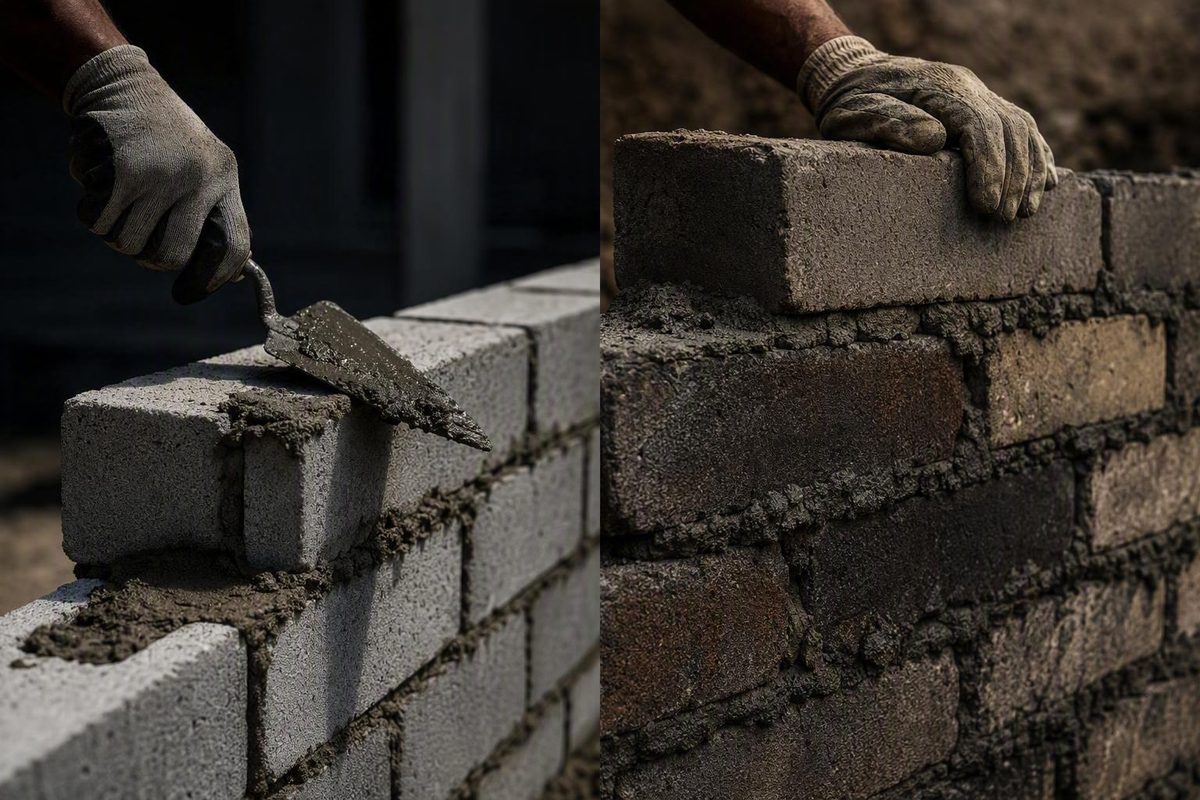
For many above-grade masonry projects in moderate conditions, Type N is the practical starting point. Type S is commonly considered when structural loads, lateral or soil pressure, below-grade placement, or exposure are more demanding. Higher strength, however, does not automatically mean a better mortar. The masonry units, wall design, moisture conditions, drawings, specifications, applicable code, and product instructions must all support the selection.
The short answer: when to consider Type N or Type S
| Project condition | Likely starting point | Qualification |
|---|---|---|
| Typical above-grade wall in moderate conditions | Type N | Confirm structural loads, exposure, masonry units, and project requirements. |
| Greater structural demand or lateral load | Type S | The engineered masonry assembly and project specification control. |
| Below-grade wall or soil pressure | Type S | Mortar does not replace proper waterproofing, drainage, reinforcement, or footing design. |
| Soft or historic brick or stone | Compatible restoration mortar—not automatically Type S | Assess the existing units and mortar before selecting a repair mix. |
| Veneer or repointing | Often Type N, but compatibility comes first | Consider unit hardness, existing mortar, moisture movement, and the support system. |
| Retaining wall | Cannot be decided from mortar type alone | Evaluate wall height, retained soil, surcharge, drainage, reinforcement, footing, and structural design. |
| Drawings or specifications name a mortar type | The specified type | Do not substitute Type N for Type S, or vice versa, without approval. |
These are commercially reported starting points rather than code or engineering rules. Commercial comparisons generally associate Type N with moderate above-grade work and Type S with heavier loads, soil pressure, and below-grade conditions, while also warning against Type S for delicate restoration or very soft masonry (commercial Type N and Type S comparison).
Grade level matters, but it is not decisive by itself. Both mortar types appear in commercial guidance for some above-grade walls, chimneys, fireplace surrounds, and exterior structures. Likewise, the phrase “retaining wall” can describe anything from decorative landscape masonry retaining little or no soil to an engineered structure resisting substantial earth pressure.
Type N vs Type S strength and workability
The most commonly cited distinction is compressive-strength classification. Commercial masonry guidance reports a 28-day laboratory value of 750 psi for Type N and 1,800 psi for Type S. The same guidance describes Type N as a moderate-strength mortar with excellent workability and Type S as a higher-strength mortar with reasonable workability (The Home Depot’s mortar-selection guide). QUIKRETE’s manufacturer mortar selector likewise lists 750 psi for its Type N products and 1,800 psi for Type S at 28 days. These are product/test values, not guaranteed strength measurements from a finished wall.
Type S offers the higher compressive-strength classification commonly considered where the assembly faces greater structural or environmental demands. Neither description guarantees the performance of a completed wall.
The cited laboratory figures are not guaranteed field strengths or measurements of hardened mortar inside a wall.
Compressive strength is also only one mortar property. Type N should not be described as categorically non-load-bearing either. Its suitability depends on calculated loads, wall geometry, reinforcement, governing requirements, and the project specification.
The useful comparison is therefore not “weak versus strong,” but moderate-strength and more workable Type N versus higher-strength Type S. The correct choice is the one that satisfies the complete wall design without creating an incompatibility with the brick, block, or stone.
Repairs and fireplaces need their own specification
For veneer or repointing, consider unit hardness, the existing mortar and moisture movement. For a retaining wall, mortar type alone cannot establish adequacy: footing, reinforcement, drainage, soil and wall geometry also matter.
Do not extend a recommendation for a fireplace surround to the firebox interior. Follow the fireplace system’s specified materials for the actual location and heat exposure.
Why stronger mortar can be the wrong mortar
Mortar selection creates a two-sided risk. Mortar that is inadequate for the wall’s structural or exposure demands may crack, deteriorate, or fail to perform as specified. Mortar that is too hard for weaker masonry may instead concentrate stress in the brick or stone, contributing to cracking, spalling, or deterioration.
Commercial restoration guidance specifically warns that excessively hard mortar can be incompatible with softer masonry, while mortar that is too weak may be inadequate under stress. It recommends considering structural demand, weather exposure, and masonry-unit compatibility instead of selecting by strength alone.
That warning does not mean Type S inevitably damages every old wall. Compatibility depends on the units, original mortar, moisture exposure, previous repairs, joint condition, and repair design. Hard modern brick can behave differently from soft historic brick or porous stone.
For historic masonry, begin by assessing the existing units and mortar rather than choosing the strongest available bag or matching color alone. The replacement mortar should work with the wall’s existing materials and moisture behavior. Significant or uncertain work may require examination or testing by an experienced restoration mason, preservation specialist, architect, or engineer.
Assess the complete masonry construction, including how repairs interact with existing units.
What ASTM C270 does—and does not—tell you
ASTM C270 covers mortars used in reinforced and non-reinforced unit masonry and provides proportion-specification and property-specification alternatives. Under the cited historical edition, the proportion specification governs when neither alternative is selected unless accepted data demonstrate compliance with the property specification. The same historical page states that field-tested compressive strengths do not represent laboratory-tested mortar strength or mortar strength in the wall, and that physical properties of field-sampled mortar are not acceptance or rejection criteria under that edition. The ASTM C270-19ae1 specification page identifies that edition as historical and lists ASTM C270-26 as active, so the active edition should be checked before treating online values, proportions, or compliance statements as current requirements.
In plain language, a field sample that does not reproduce a published classification value is not, by that fact alone, proof that installed mortar fails ASTM C270. Classification testing, field sampling, and actual in-wall behavior are not interchangeable measurements.
ASTM classification also does not select the mortar type for a particular project. The designer or specification must still account for structural demand, exposure, masonry units, reinforcement, and applicable code provisions. Similarly, a packaged mortar marketed as complying with Type N or Type S requirements does not establish that the stated type is appropriate for every wall.
Field proportions, packaged mortar, and final checks
Commercial guidance commonly reports these approximate cement-lime-sand proportions by volume:
- Type N: 1 part cement, 1 part lime, and 6 parts sand
- Type S: 1 part cement, 0.5 part lime, and 4.5 parts sand
These 1:1:6 and 1:0.5:4.5 proportions are commercially reported examples, not universal recipes (commercial mix comparison). Sand grading and moisture, material type, measurement accuracy, batching method, specification method, and project requirements can all affect what is permitted. A generic ratio must not override the drawings, an approved mix design, or manufacturer instructions.
Packaged Type N and Type S products are also available. With a packaged mortar, follow the current product data sheet for water quantity, mixing, application, temperature precautions, and curing.
As one manufacturer-specific example, QUIKRETE identifies Mortar Mix No. 1102 as a Type N product for laying or repairing brick, block, and stone. The manufacturer reports a 28-day compressive strength exceeding 750 psi and provides product-specific mixing and application directions in its technical data sheet. Those claims apply to that product, not to every Type N mortar.
Before ordering, mixing, or approving mortar:
- Read the drawings, masonry notes, and project specification.
- Determine whether the work is above or below grade.
- Identify gravity, wind, seismic, lateral, and soil-pressure demands where applicable.
- Assess moisture, drainage, saturation, temperature, and exposure.
- Identify the brick, block, or stone and evaluate its compatibility with the proposed mortar.
- For repairs, examine the existing mortar and joint condition rather than matching color alone.
- Check the active ASTM standard, applicable building code, and local amendments.
- Follow the current data sheet when using packaged mortar.
- Obtain approval before changing a specified mortar type.
- Seek qualified design or preservation guidance when the work is structural, historic, retaining soil, or otherwise unclear.
Type N remains a common starting point for moderate, above-grade masonry, while Type S is commonly considered for greater structural demand, lateral or soil pressure, below-grade conditions, and demanding exposure. The final choice belongs to the complete wall system—not merely to the mortar with the highest compressive-strength number.