
Portland Cement Is the Binder, Not the Concrete Mix
Learn how portland cement differs from concrete and mortar, what clinker and gypsum do, and how ASTM cement types affect purchasing and specification.
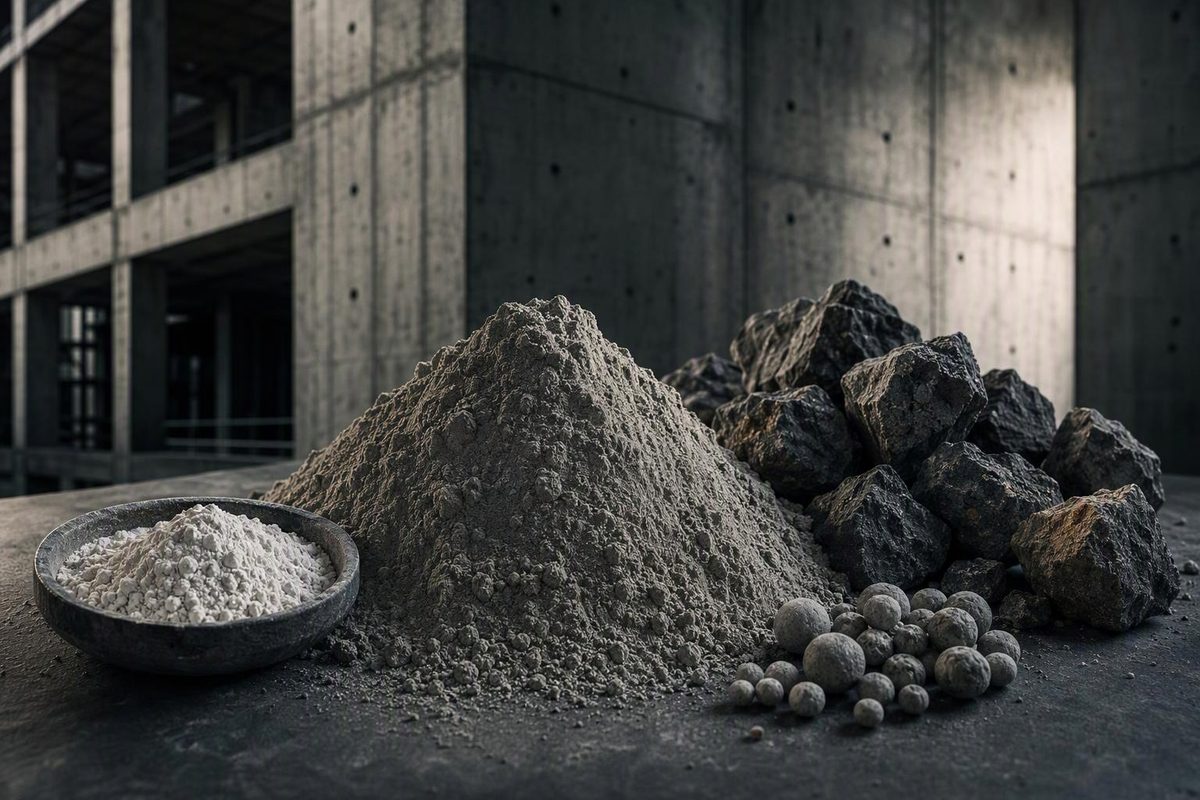
Portland cement is a finely ground hydraulic binder—a powder that reacts chemically with water to set and harden. In concrete, the resulting cement paste binds sand and coarse aggregate into a solid mass. It is an ingredient, not a complete concrete mix: a bag of portland cement does not contain the sand and stone needed for ordinary concrete. “Hydraulic” means it can harden under water; the process does not depend on drying out. The American Cement Association explains this distinction between the binder and the finished material.
Choose the material you want to make; the tool shows what belongs in it.
Binder or Complete Mixture?
A bag of portland cement is not enough.
Ingredients: portland cement, water, sand and coarse aggregate such as gravel or crushed stone.
Mix proportions are not supplied here. Use the applicable product instructions or specified concrete mixture.
| Material | Ingredients | Meaning |
|---|---|---|
| Portland cement | Powdered binder | Ingredient |
| Cement paste | Cement + water | Binding paste |
| Concrete | Paste + sand + coarse aggregate | Combined material |
| Portland-lime mortar | Cement + lime + masonry sand + water | One mortar formulation |
Limits of This Comparison
Portland-lime mortar is not the definition of every masonry mortar. Check a bag's label to distinguish a binder from a prepared mix. Ingredient names do not establish mix proportions, concrete strength or cement-type suitability.
Sources: American Cement Association, cement and concrete FAQ; QUIKRETE, portland cement product instructions.
Portland Cement Is Only One Part of Concrete
The distinction matters at the bag, the mixer and the specification desk. Buying portland cement supplies the binder. Buying a prepared concrete mix supplies a different product, with ingredients already combined as described on its label. The word “cement” alone is not enough to establish what is inside a bag or what must be added.
| Material | What It Contains | What the Name Identifies |
|---|---|---|
| Portland cement | Powdered binder | An ingredient |
| Cement paste | Cement and water | The binding paste |
| Concrete | Paste, sand and coarse aggregate | The combined material |
| Portland-lime mortar | Cement, hydrated lime, masonry sand and water | One mortar formulation |
Cement paste is what forms when portland cement meets water. Add fine aggregate, usually sand, and coarse aggregate, such as gravel or crushed stone, and the combination is concrete. The paste binds the aggregate; calling the whole mixture “cement” hides that distinction.
Portland-lime mortar has a different ingredient list. It combines portland cement with hydrated lime, masonry sand and water. That is one way to formulate masonry mortar, not the definition of every mortar product. A bag labeled masonry cement or mortar cement should not be treated as interchangeable with a bag of portland cement solely because each name includes “cement.”
QUIKRETE’s portland cement instructions distinguish the added ingredients for concrete and portland-lime mortar. Those instructions apply to that product; they are not a universal recipe for every cement or every project.
For the complete mixture rather than the binder alone, see what concrete is made of. For the differences that matter in masonry specifications, see mortar cement, masonry cement and portland-lime compared.
Clinker and Gypsum Make the Finished Powder
Manufacturers proportion raw materials that supply calcium, silicon, aluminum and iron. Limestone is a common calcium source. Clay, shale and other materials supply the remaining constituents. The raw ingredients are selected and combined for cement manufacture; the finished product is not simply ground limestone.
Heating the prepared mixture in a kiln produces clinker, a rock-like intermediate. Manufacturers then grind the clinker into the fine powder sold as cement. The American Cement Association’s manufacturing guide describes this sequence from raw materials through kiln processing to the finished binder.
Clinker is therefore neither the coarse aggregate in concrete nor another name for the bagged powder. It is an intermediate in cement production. The gravel or crushed stone added when making concrete has a separate role in the final mixture.
The finished cement also contains calcium sulfate, commonly gypsum, and may contain limestone and permitted processing additions. These are constituents of the manufactured binder, rather than a substitute for the sand and stone needed to make ordinary concrete.
Gypsum has a specific function: it controls the cement’s setting time, allowing the mixed material to be handled and placed before it stiffens. It is not aggregate or reinforcement. The Minerals Education Coalition’s gypsum guide identifies this use in cement manufacture.
That distinction between constituents and added aggregate helps explain the bag label. A cement can contain more than clinker and still be a binder requiring additional materials. Its composition does not make it a ready-to-use concrete mixture.
Hydration Hardens Cement; Drying Does Not
When water contacts cement, hydration reactions produce solid compounds, including calcium silicate hydrate. These products bind particles together and progressively occupy space within the paste. As hydration advances, concrete gains strength and becomes less permeable. The reactions also release heat, as described in FHWA’s curing technical brief.
This is why “let it dry” is the wrong description of how concrete develops strength. Water participates in the chemical reactions. Removing moisture prematurely can interrupt the process rather than help it along.
Curing provides sufficient moisture and suitable temperature to sustain hydration. It is not a separate ingredient and it is not simply a waiting period. It concerns the conditions maintained after placement so that the cement in the mixture can continue reacting.
The fact that portland cement is hydraulic does not eliminate the need for curing. Its ability to harden under water explains the chemistry; it does not establish that any moisture or temperature conditions on a job site will be adequate. The curing approach still has to suit the concrete and the work.
Nor does a surface that appears dry establish that the concrete has reached its specified strength. Surface appearance, cement type and concrete strength describe different things. None should be used as a substitute for the project’s strength requirements or permission to load the work.
More Mixing Water Can Reduce Strength
Water quantity affects performance as well as handling. Increasing the water-to-cement ratio can reduce concrete strength. Adding water to make a mixture easier to place is therefore a mixture-design change, not merely a convenience at the mixer.
The water-to-cement ratio compares the amount of water with the amount of cement in the mixture. It concerns proportions, not just whether the concrete looks wet or stiff. A visual judgment of workability does not establish that the proportions meet the specification.
This article does not provide a numerical water-to-cement ratio or a universal mixing recipe. Those figures must come from the applicable product instructions or the project’s mixture requirements. Knowing what portland cement is does not establish how much water, sand or stone a particular application needs.
Cement alone also does not determine concrete strength. Aggregate quality, mixture proportions and curing matter. A cement type designation can identify a required binder property, but it cannot replace a specified concrete compressive strength or the mixture submitted to achieve it.
ASTM Types Identify Properties, Not Complete Recipes
For U.S. specifications using ASTM C150/C150M-24, the non-air-entraining portland cement types listed in its scope are shown below. The same standard addresses cement composition and storage, including protection from dampness. These classifications belong to that standard and edition; they should not be assumed to describe every cement label in every jurisdiction.
| Type | Intended Use or Property |
|---|---|
| I | General use where special properties are not required |
| II | General use, especially where moderate sulfate resistance is desired |
| III | High early strength |
| V | High sulfate resistance |
A Type I/II product meets both classifications. It is not a separate concrete recipe. The label identifies the requirements the cement meets, while the concrete mixture still needs its own aggregate, water proportions and performance requirements.
Type III’s high-early-strength designation likewise does not grant permission to load newly placed concrete. It identifies a cement property, not the achieved strength of a particular placement. Actual concrete performance still depends on the mixture and curing conditions.
Types II and V distinguish moderate and high sulfate resistance, respectively. Choosing between them requires the project’s exposure requirements; the presence of a type number on a bag does not by itself establish suitability for the site.
ASTM C150/C150M-24 also advises checking availability before specifying a type other than Type I. A type that fits the intended requirement still has to be obtainable for the work. Availability does not, however, justify substituting a different type without checking the specification.
Type IL Belongs to a Different Cement Standard
Type IL identifies portland-limestone cement, a blended hydraulic cement under ASTM C595 rather than a C150 portland cement type. It should not be read as another entry in the C150 table above.
Other blended cements incorporate slag or pozzolans. The American Cement Association’s cement classifications distinguish these products from portland cement classifications. Blended cements can serve general concrete applications, but required special properties must be documented.
The distinction is between product standards, not between “cement” and “not cement.” A blended hydraulic cement is still a binder. What changes is the classification and the documentation needed to demonstrate that it meets the project’s requirements.
A similar name is not enough for a substitution. If the specified product is a C150 portland cement and the proposed product is a C595 blended cement, compare the required standard, exposure properties and submitted mixture. Do not infer equivalence from the shared word “portland.”
The Bag Label Must Match the Intended Work
Before purchasing, establish whether the product is a binder requiring added ingredients or a prepared mix. That check comes before comparing cement types: a binder and a complete concrete mix answer different needs, even when their packaging uses similar language.
Next, read the standard and type in the technical documentation. “Portland cement” identifies the material family, but the classification supplies the more specific requirements. Where a project specification governs the work, use that specification rather than treating a general-use designation as sufficient evidence of suitability.
For a proposed substitution, check the specified standard, exposure requirements and submitted concrete mixture together. Comparing names alone can miss the difference between portland cement and portland-limestone cement, or between a binder classification and the performance required of the finished concrete.
The same separation applies when ordering materials for masonry. Portland-lime mortar requires hydrated lime and masonry sand as well as portland cement and water. Buying only the binder does not supply the complete formulation. Conversely, instructions for that formulation should not be applied automatically to a different mortar product.
Where the documentation does not supply a mix proportion, strength figure or loading time, those values remain unknown. They cannot be inferred from the definition of portland cement or filled in with a single rule that supposedly applies to all concrete work.
Keep Cement Dry in Storage and Off Skin During Use
Protect cement from dampness during storage, as ASTM C150 requires. This follows directly from the material’s behavior: water triggers the reactions intended to occur during mixing, not while the powder is being stored.
Handling introduces a different concern. Wet cement can cause caustic burns without immediate pain. The OSHA portland cement safety guide explains the hazard and the need to prevent skin contact. A lack of immediate discomfort is not evidence that contact is harmless.
Follow the product safety data sheet. Use suitable gloves, waterproof boots where needed, clean protective clothing and eye protection. Keep wet cement from becoming trapped inside gloves, boots or clothing; protective equipment cannot serve its purpose if it holds the wet material against the skin.
These precautions apply when the binder is part of a wet mixture, not only when handling a bag marked “portland cement.” Understanding the ingredient helps identify both the material being specified and the exposure being managed on site.