
What Is Concrete Made Of? Ingredients and Their Roles
Concrete combines cement, water, sand and stone. Learn how aggregates, admixtures, water ratio and curing affect strength and construction.
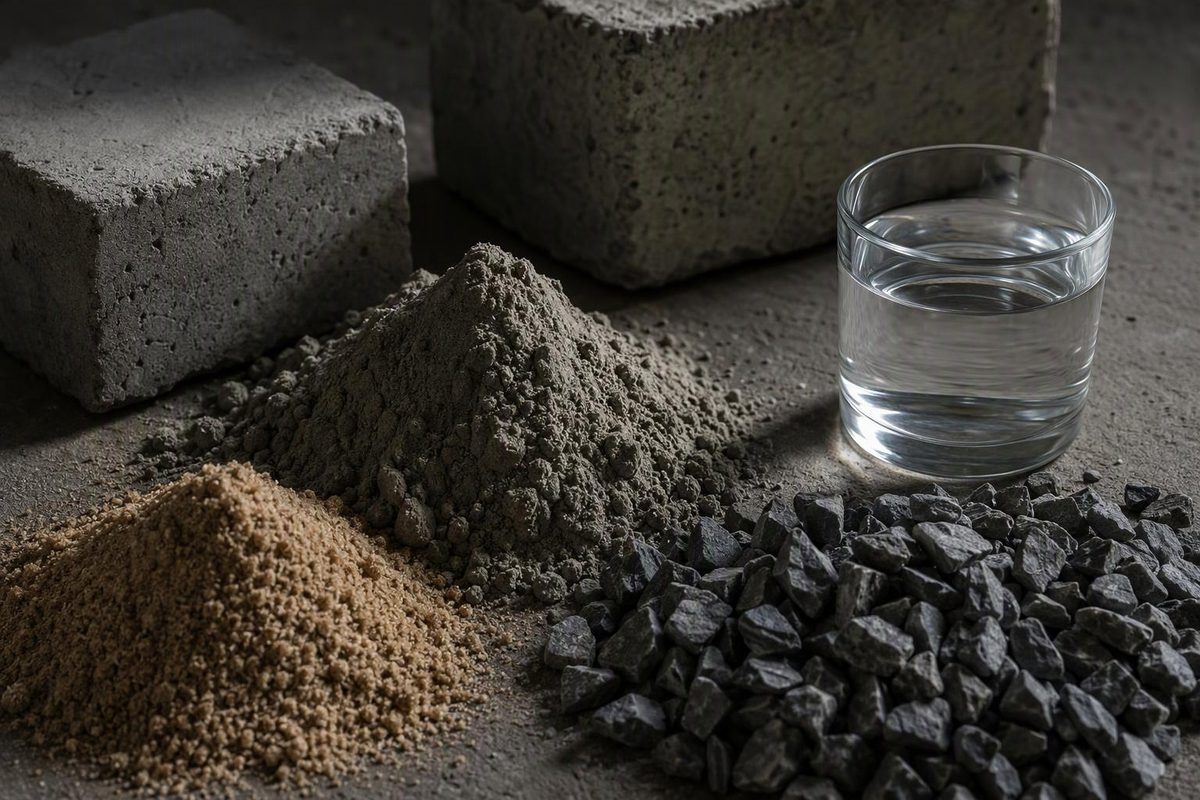
Conventional concrete is made of cement, water, fine aggregate—usually sand—and coarse aggregate, usually gravel or crushed stone. Cement and water form a paste that coats and binds the aggregate particles. Many mixtures also contain supplementary cementitious materials and chemical admixtures to adjust strength, durability and placement characteristics. NRMCA’s material overview explains this paste-and-aggregate structure.
Cement is therefore an ingredient of concrete, not another name for it. The distinction matters when ordering materials: a bag of cement supplies the binder, not the complete concrete mixture.
The main ingredients and what they do
| Ingredient | What it is | Role in concrete |
|---|---|---|
| Cement | A finely ground hydraulic binder, commonly portland or blended cement | Reacts with water to form the hardened paste that binds the aggregates |
| Water | Mixing water suitable for concrete production | Enables the chemical reaction and helps give fresh concrete its workable consistency |
| Fine aggregate | Sand or other suitable fine mineral particles | Occupies spaces between larger particles and forms part of the aggregate structure |
| Coarse aggregate | Gravel or crushed stone | Provides much of the mixture’s bulk |
Aggregates typically account for 60–75% of concrete’s volume. Their grading—the distribution of particle sizes—affects how efficiently particles pack together and how much paste is needed. Too little paste makes concrete difficult to place and can leave rough, honeycombed areas; excess paste can increase cracking tendency and cost. These are mixture-design issues, not simply a question of adding more cement. Source: NRMCA
Cement itself is manufactured rather than quarried as a finished powder. Limestone, marl and clay are common sources of its principal elements: calcium, silicon, aluminum and iron. Raw materials are heated at high temperatures to form a rock-like substance, then ground into a fine powder. The American Cement Association describes the manufacturing process.
What else can be in the mixture?
Supplementary cementitious materials (SCMs) form part of the binder. Examples include fly ash, slag cement, silica fume and calcined clay. They may be incorporated in blended cement or batched separately at the concrete plant. Depending on the material and proportion, they can change workability, setting time, strength development, heat generation and permeability. Some mixtures gain strength more slowly at first, making curing and construction timing important. NRMCA’s SCM guidance explains these trade-offs.
Chemical admixtures adjust particular properties:
- Water reducers improve workability without requiring additional water, or reduce water demand for a given consistency.
- Retarders delay setting to provide more placement and finishing time.
- Accelerators speed setting and early strength development; they do not make concrete immune to freezing.
- Air-entraining admixtures create microscopic air bubbles that improve resistance to freeze–thaw damage.
Entrained air is intentional and controlled; it is not the same as leaving large voids through inadequate consolidation. Admixture selection should suit the cementitious materials, exposure and construction method. Source: NRMCA’s chemical admixture guidance
Why the water ratio matters
The ingredient list alone does not establish performance. A key variable is the water-to-cementitious-materials ratio, written w/cm: the mass of mixing water divided by the total mass of cementitious materials.
For example, 180 kg of mixing water divided by 400 kg of cementitious materials gives a w/cm of 0.45. This illustrates the calculation, not a recommended mix for every application.
Adding water beyond the designed amount can reduce strength and durability and increase cracking potential. Jobsite water adjustment is not automatically prohibited, but where the project permits it, additions must stay within the permitted water ratio and consistency limits and be measured and recorded. Coordinate any adjustment with the concrete supplier; a water-reducing admixture may offer another way to adjust workability. NRMCA’s jobsite water guidance sets out these distinctions.
Concrete hardens by reaction, not simply by drying
Cementitious materials react with water through hydration. Curing maintains moisture and suitable temperature so that reaction can continue. Allowing newly placed concrete to dry prematurely can prevent it from developing the intended strength and surface durability. Source: NRMCA’s curing guidance
For drawings and specifications, treat concrete as a designed material rather than a universal cement–sand–stone recipe. Coordinate the mixture with exposure, member thickness, placement access, required strength and curing. Aggregate size must suit the section being cast and the clear spacing of reinforcement, so concrete can pass around the bars without blockage and honeycombing. ACI’s aggregate-size guidance explains that relationship. When detailing a rebar cage, those spaces help determine whether the ingredients can become the finished member the design requires.