
Before You Choose a Mortar Binder, Separate the Product, Mortar Type, and Workmanship
Frames selection and substitution around the binder route, finished-mortar requirements, governing editions, product documentation and field controls.
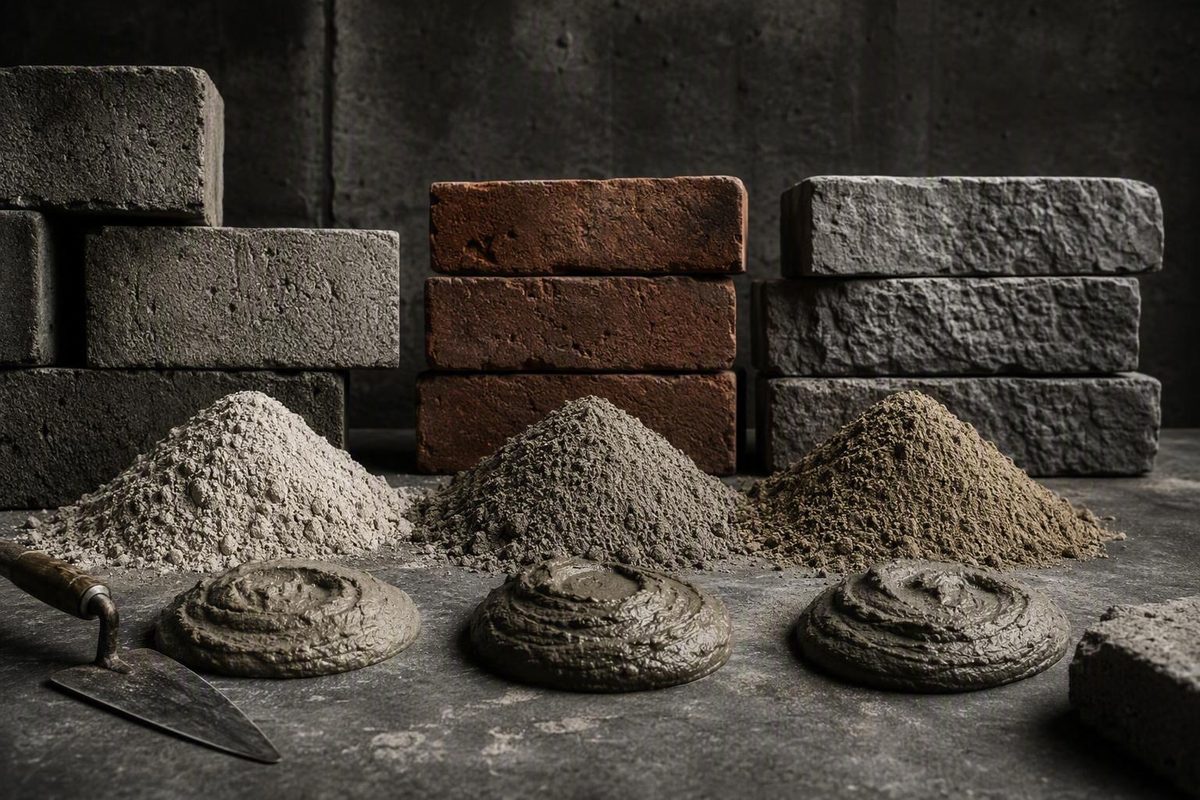
For specification and substitution review, treat mortar cement selection, finished-mortar classification, and field workmanship as three coordinated checks. Compare mortar cement, masonry cement, and site-mixed Portland cement-lime only after confirming the current standards and project requirements for each proposed route.
Start with three separate decisions
Organize the decision around three layers:
- Binder system: Identify the proposed product or constituent combination, its governing material standard and edition, and the manufacturer’s instructions.
- Finished mortar: Confirm the required mortar classification, applicable specification route, tests, and acceptance criteria.
- Field execution: Establish how materials will be stored, measured, mixed, adjusted, placed, tooled, and documented.
This is a coordination framework rather than a claim that binder standards and mortar classifications are technically unrelated. Their precise relationship must be confirmed in the current primary standards governing the project.
The Brick Industry Association identifies ASTM C270 as the Standard Specification for Mortar for Unit Masonry. Its Technical Note 7B primarily addresses brick construction and workmanship, however, rather than defining or comparing mortar cement, masonry cement, and site-mixed Portland cement-lime.1
Keeping the three layers visible is especially useful during substitution review. A proposed product name does not, by itself, show that the resulting mortar classification, specification route, submittals, testing, and field procedures remain consistent with the controlling documents.
What must be verified before comparing the three binder routes
The available workmanship guidance does not establish the current material standards or permitted constituents for the three binder routes. Those details must come from the applicable editions of the primary standards, project documents, and approved product data.
Use this table as a decision gate rather than as a generic product ranking:
| Decision item | Mortar cement | Masonry cement | Site-mixed Portland cement-lime |
|---|---|---|---|
| Binder documentation | Record product and current governing standard | Record product and current governing standard | Record each constituent and its current governing standard |
| Permitted constituents | Confirm against standard and product data | Confirm against standard and product data | Confirm each proposed constituent |
| ASTM C270 relationship | Establish permitted route and classification | Establish permitted route and classification | Establish permitted route and classification |
| Testing and acceptance | Record project-required evidence | Record project-required evidence | Record project-required evidence |
| Field control | Document batching method and tolerances | Document batching method and tolerances | Document constituent measurement and batching controls |
| Submittals | Product data, certificates, and instructions as required | Product data, certificates, and instructions as required | Data and certificates for each constituent as required |
| Estimating inputs | Quote actual delivery, storage, equipment, and labor conditions | Quote actual delivery, storage, equipment, and labor conditions | Quote actual delivery, storage, equipment, and labor conditions |
| Approval status | Do not proceed until documented | Do not proceed until documented | Do not proceed until documented |
This comparison separates useful project questions without assuming their answers. For example, a route involving separately proposed constituents should be evaluated using the documentation and field controls applicable to those constituents. That does not establish that the route is better, worse, cheaper, or more difficult than a packaged binder.
The same boundary applies to performance. Binder names alone do not support a ranking for bond, strength, workability, water retention, durability, consistency, cracking, labor, or cost. Nor should a project team assume that every proposed binder can produce every mortar classification through every ASTM C270 route.
Estimators can still compare the real procurement and execution package. Obtain project-specific information for delivery, packaging, storage, batching equipment, separate-material handling, pigments, admixtures, waste, testing, records, crew familiarity, and local availability. A substitution should be priced and reviewed as a change to the complete mortar system—not simply as a change in bagged product.
A specification and code edition check
Review the following documents for edition, applicability, and consistency:
- The locally adopted building code and amendments.
- The TMS edition referenced by that code or the project documents.
- The drawings, specifications, schedules, and approved changes.
- The applicable ASTM editions for the proposed binder, constituents, and finished mortar.
- Approved product data, certificates, and submittals.
- Instructions for the exact products and formulations proposed.
This is a verification sequence, not a universal hierarchy of legal or contractual precedence. If the documents conflict, the responsible parties must resolve the issue under the applicable code and contract-document framework.
The Masonry Society describes TMS 402-16 as covering masonry design and construction and TMS 602-16 as establishing minimum construction requirements. Its page relates those standards to the 2018 International Building Code, so it does not establish which edition governs a current project in every jurisdiction. The page also distinguishes the standards from their commentaries: the standards are written for adoption by reference, while the commentaries provide informational background, committee considerations, and research context. Review The Masonry Society’s description of TMS 402/602-16.
Create one project record showing:
- proposed binder product or constituent combination;
- verified material standard and edition for each product;
- required finished-mortar classification;
- selected specification route;
- applicable code, TMS, ASTM, and contract-document editions;
- pigments, integral water repellents, and other admixtures;
- approved product data and manufacturer instructions;
- required batch proportions or other batch information; and
- certificates, tests, inspection records, and acceptance documentation.
This record is a coordination checklist, not a model specification or a representation of code compliance. It makes omissions visible before procurement and provides a defined basis for reviewing substitutions.
Binder selection does not replace brick-mortar quality control
The practices in this section come from BIA guidance for brick masonry. Do not transfer them unchanged to CMU, stone, reinforced masonry, or restoration work without confirming the requirements applicable to those assemblies.
Water-resistant brick masonry depends on material preparation, mortar handling, flashing, complete joint filling, tooling, and workmanship.
For brick mortar, the BIA guidance recommends accurate batching and the maximum amount of water that still produces workable mortar. It also says mortar water retention may need to be adjusted for the brick’s initial rate of absorption while remaining within ASTM C270 limits. Those adjustments remain subject to the project requirements and instructions for the products being used.1
Cementitious materials and aggregates should be mechanically mixed for at least three minutes and no more than five minutes. The mortar should be used within 2.5 hours after initial mixing, reduced to two hours in hot weather, and never after setting begins.1
Mortar that stiffens because water has evaporated may be retempered within the applicable limits, but that guidance is not permission to revive mortar after setting begins. Retempering colored mortar can cause significant color variation, so the project specification and instructions for the exact product still control.1
For exterior brick wythes, joints intended to contain mortar should be completely filled. The BIA guidance calls for tooling at thumbprint hardness with a concave, V, or grapevine jointer. Joint filling and tooling work together with properly detailed and installed flashing; they are not consequences of choosing one binder route rather than another.1
A defensible decision workflow
Step 1: Identify the masonry assembly. Confirm the unit type, wall configuration, exposure, and scope of work. Keep brick-specific guidance within its documented scope rather than extending it automatically to CMU, stone, or existing and historic masonry.
Step 2: Establish project constraints. Have the responsible design professional verify structural requirements, exposure conditions, preservation needs, appearance criteria, and specification restrictions. Treat pigments and admixtures as compatibility, approval, and documentation issues.
Step 3: Establish the standards path. Retrieve the current governing standard for every proposed binder or constituent and the applicable ASTM C270 edition. Determine whether the proposed products, mortar classification, and specification route are permitted together. If that relationship cannot be documented, stop the review rather than inferring acceptance from a product name.
Step 4: Compare complete project costs. Evaluate supplier availability, delivery, packaging, storage, batching equipment, constituent control, crew familiarity, pigments, admixtures, testing, records, waste, and labor using project-specific quotations and technical data. Do not convert a difference in packaging into an unsupported claim about total installed cost.
Step 5: Resolve inconsistencies before procurement. Reconcile the adopted code, referenced standards, project documents, approved submittals, and instructions for the exact products. An approved product name should not conceal an unresolved conflict involving mortar classification, proportions, testing, or field procedures.
Step 6: Monitor brick construction. Record batching, water adjustments, mixing time, elapsed use time, retempering, joint filling, tooling, and flashing installation. Where colored mortar is used, maintain the controls needed to limit visible variation.
The stop/go rule is straightforward: do not select or substitute a mortar binder from its product name or a Type N or Type S label alone. Proceed only when the proposed binder route, finished-mortar requirements, governing editions, product documentation, and field controls have been reconciled. Without that project-specific verification, no universal performance winner among mortar cement, masonry cement, and site-mixed Portland cement-lime is defensible.
Is choosing mortar cement the same as choosing Type N or Type S mortar?
Do not treat the two labels as interchangeable during specification review. Use them as prompts for separate documentation: identify the proposed binder and its governing requirements, then confirm the finished-mortar classification and permitted specification route under the applicable current standards.
How long should brick mortar be mechanically mixed and used under the cited BIA guidance?
Mechanically mix the cementitious materials and aggregates for at least three minutes and no more than five minutes. Use the mortar within 2.5 hours after initial mixing, or within two hours in hot weather, and never after setting begins.1
Can stiffened mortar be retempered with water?
Under the cited BIA brick guidance, mortar stiffened by evaporation may be retempered before setting begins and within the applicable use-time limit. This does not permit retempering mortar after setting has started. Colored mortar requires particular care because additional water can cause significant color variation; the project requirements and instructions for the exact product still control.1