
What the Reported 2027 Code Path for Reclaimed Structural Lumber Actually Requires
Reported 2027 IBC salvaged-lumber pathway explained: who may verify, what the 90% design-value cap means, and why local adoption still decides your project.
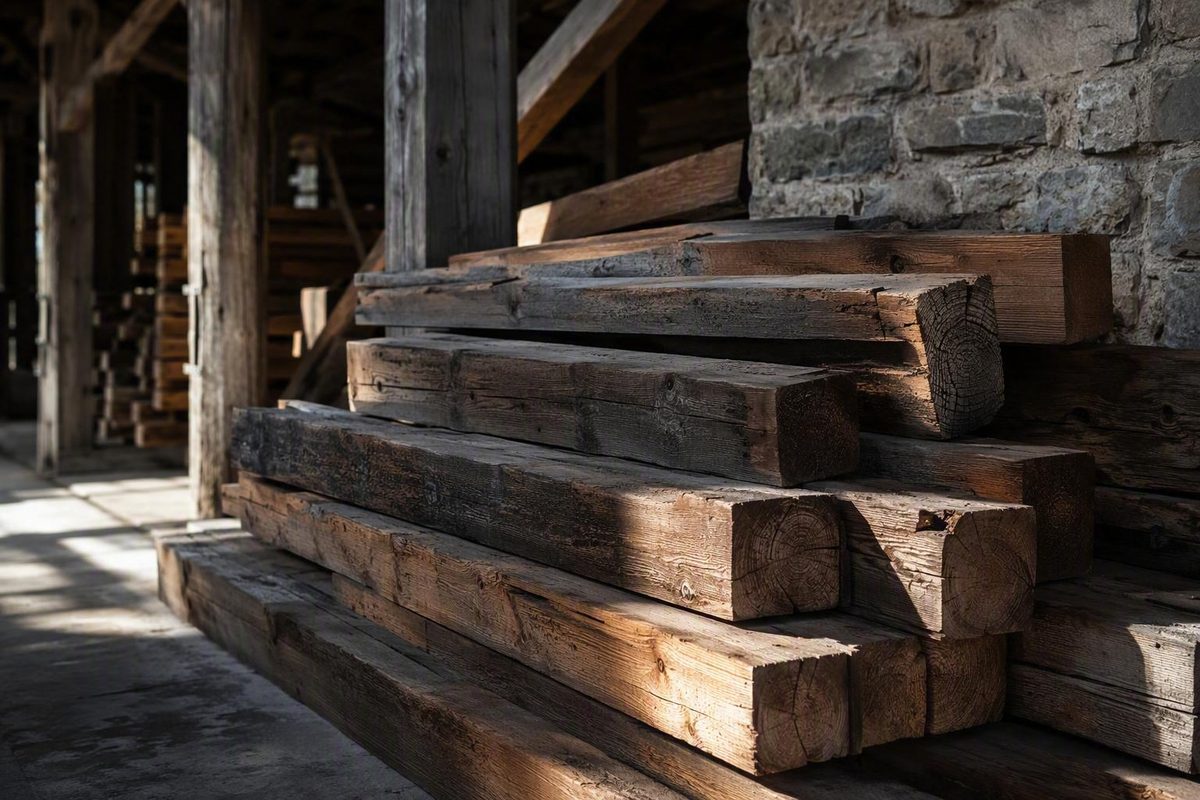
Trade and professional-association sources report that the 2027 International Building Code will carry a conditional path for structural use of salvaged lumber. A member qualifies only after evaluation by an approved verifier, and its design values are capped at up to 90% of standard values. That is not nationwide permission: no official ICC text naming the provision appears in the available sources, and a model code governs a project only after the jurisdiction adopts it.
NAHB reports approval affecting the IBC and IRC and describes the evaluator as a certified lumber grader. NCSEA describes the reported IBC pathway using the broader term “approved entity.”
Until the published section is in hand, this is an implementation preview. Before specifying or buying reclaimed structural members, confirm the enforced code, get the verifier accepted in writing, establish defensible design values and keep every member traceable through inspection.
Set the three conditions for your member; the verdict and next steps update beside them.
Reclaimed Member Code-Path Check
Default: an unstamped barn beam proposed as a floor beam.
Flags: decay, insect activity, char or heat, structural cracks, severe splits, delamination, clustered holes, crushed fibers, deep warp, prolonged moisture damage.
No stamp and no report means no design values, so it cannot be sized as a floor beam yet.
- Confirm the enforced code edition, local amendments and effective date with the building department before buying more stock.
- Get a written answer from the building official on who may verify. NAHB reports a certified lumber grader; NCSEA reports an approved entity that may include a grading agency or registered design professional.
- Have that verifier evaluate grade, decay, fire damage, insect damage, structural integrity and heat exposure.
- Floor beam: check the bearing seat, bolt groups and old fastener holes against the new connection layout.
Add member details (optional)
A cap, not the member's value. The baseline itself is unresolved in the available sources, and the engineer may assign less.
All six outcomes
| Situation | Verdict | Next step |
|---|---|---|
| Any screening flag present | Use non-structurally for now | Segregate, record, refer to the evaluator and engineer |
| No flags, no stamp or report | Needs grading | Get the verifier accepted in writing, then evaluate |
| Evaluated, verifier not accepted | Needs an accepted verifier | Resolve qualifications before procurement |
| Accepted evaluation, provision adopted | Fits the reported 2027 IBC path | Engineer assigns values at or below the 90% ceiling; plan review; field IDs |
| Accepted evaluation, provision not adopted | No 2027 path locally | Alternative-material, reused-material or appeal process |
| Accepted evaluation, code not checked | Confirm the code first | Edition, amendments, effective date |
Sources: NCSEA Sustainability Spotlight (May 2026), NAHB (Aug 2026), AWC 2025 annual report; screening flags from Portland Permitting & Development. Reported provisions, not published code text. The building official decides.
Secondary Sources Report Approval; ICC Confirms Only the Process
| Category | What the evidence establishes |
|---|---|
| Reported code change | NCSEA, NAHB and trade publications report a structural-use pathway for salvaged lumber in the 2027 IBC; secondary reports also tie a provision to the 2027 IRC. |
| Confirmed ICC milestone | ICC says the 2024–2026 cycle reached final action and that Group A and B final-action results became available on July 13, 2026. |
| Unresolved code details | ICC’s process pages do not identify the proposal, reproduce its language or give a section number, definitions or exceptions. |
| Jurisdiction-dependent | Enforceability depends on governmental adoption, amendments and the local effective date, then review and acceptance for the project. |
NAHB says structural reuse was approved when salvaged lumber is evaluated by a certified lumber grader. It listed September 2026 as the anticipated publication month for the 2027 IBC and February 2027 for the IRC. Those are publication schedules, not code text.
ICC describes a process of committee consideration, public-comment hearings and voting by eligible governmental representatives. Its process page does not connect the posted results to a named salvaged-lumber proposal or state the final requirements. ICC records the final-action milestone and the voting stages before it.
The American Wood Council reported that two proposals supporting structural use of salvaged lumber were approved with modifications during code development. AWC characterized the modifications as addressing consistency and safety. Its account does not establish the final wording or the documentation rules that follow from it. AWC describes the two proposals and their modified approval.
The 90% Figure Is a Ceiling, Not a Multiplier
NCSEA reports that salvaged lumber may be assigned up to 90% of standard design values when verified by an approved entity, potentially including a grading agency or registered design professional. It also reports evaluation for grade, decay, fire damage, insect damage, structural integrity and heat exposure.
“Up to 90%” does not mean every reclaimed beam, joist or stud starts with a known new-lumber value and receives a 0.90 factor. The baseline has to be established first, and the engineer may assign less than the cap.
| Topic | Reported by secondary sources | Open in final code text |
|---|---|---|
| Verifier | An approved entity; accounts differ on who qualifies | Certified grader only, or also a grading agency or registered design professional |
| Value limit | Up to 90% of standard design values | The baseline values and when the maximum applies |
| Condition | Grade, decay, fire, insect damage, integrity, heat exposure | Acceptance thresholds and concealed-condition procedures |
| Grading | A grade-related evaluation | Which grading rules apply; mixed or uncertain stock |
| Documentation | Nothing established | Report form, photographs, retention period |
| Member marking | Nothing established | Marks, labels, certificates or inventory numbers |
| Testing | No trigger established | Whether testing is mandatory; whether sampling is allowed |
The verifier question is a real discrepancy. NAHB says certified lumber grader. NCSEA says approved entity, which may include grading agencies or registered design professionals. Do not treat those as interchangeable without the controlling text.
The summaries also leave the engineering inputs open:
- which published design values form the baseline for the 90% maximum;
- how species or species group must be identified;
- how moisture content and actual dressed dimensions are recorded;
- how section loss, wane, checks, splits, holes and notches enter the values;
- which duration, repetitive-member, wet-service or other adjustment factors apply;
- whether every piece is examined or a lot may be sampled;
- how old fastener locations and damaged connection zones are handled;
- when nondestructive or destructive testing is required;
- whether members with uncertain exposure histories can receive assigned properties at all.
Approval, Publication, Adoption and Enforcement Are Separate Milestones
A favorable vote is one step of seven.
| Stage | What it establishes | What it does not |
|---|---|---|
| Code proposal | Language enters development | Approval or enforceability |
| Final action | The process reaches a voting result | Publication of the model code |
| Model-code publication | The edition becomes available | Adoption by a government |
| State or local adoption | A jurisdiction enacts an edition, often amended | The date it becomes enforceable |
| Local effective date | Requirements begin governing defined work | Approval of a material or project |
| Permit review | Design and records are reviewed | Acceptance of later substitutions |
| Field inspection | Installed work is compared with approved documents | Approval of undocumented changes |
The sources disagree on timing. ICC says final-action results became available on July 13, 2026. Green Home Builder refers to final vote results dated September 1, 2026 and reports approval of salvaged-lumber provisions in both the IBC and IRC. The available evidence does not resolve the difference. Green Home Builder reports the September date and the IBC/IRC outcome.
An anticipated September release does not prove an edition was published or fix its operative language. Check ICC’s current code catalog or Digital Codes platform for the text before relying on the reported change.
A published I-Code is still not law. ICC explains that its model codes become legally applicable through adoption by governmental jurisdictions, which may amend provisions or keep using an earlier edition. ICC’s IBC preface explains governmental adoption and amendment. For another timber question that turns on state adoption rather than the model code, see Can You Build Mass Timber in Florida? 2026 Code Guide.
For each project, record the code governing the occupancy and project type, the edition enforced, state and local amendments, the local effective date, transition rules for pending permits, and written direction from the authority having jurisdiction.
“2027” in the title is not an effective date. The reported IBC and IRC provisions should not be assumed to share scope, definitions, verifier qualifications or design limits. Compare the controlling language before applying an IRC summary to an IBC project, or the reverse.
Settle the Verifier and the Inventory Before Buying Stock
The common failure is buying an attractive batch first and trying to approve it later. If individual pieces cannot be evaluated or tied to the calculations, the assumed structural supply may not be usable as designed. The sequence that avoids it:
- Identify the governing code. IBC, a residential code or another local framework; record the enforced edition, amendments and effective date.
- Meet the authority having jurisdiction before procurement. Ask whether an adopted salvaged-lumber provision applies. If not, ask whether the project can proceed under an existing alternative-material, reused-material or appeal process.
- Confirm the acceptable verifier in writing. A lumber grader, a grading agency and a registered design professional are not interchangeable until the official says so.
- Create a member inventory. Give each candidate piece a unique ID. Record source location, photographs, actual cross-section and length, presumed species, visible condition and proposed structural use.
- Screen first, then evaluate. Do preliminary defect screening before paying for detailed review, then the grading, professional evaluation or testing the jurisdiction requires.
- Establish usable structural properties. The structural engineer coordinates assigned values with actual dimensions, loads, spans, bearing, connections, holes, notches and section loss, and states substitution criteria explicitly.
- Submit a coordinated package. Evaluation reports, verifier credentials, calculations, inventory references, plans and details go in together at permit review.
- Carry identity into the field. Inventory IDs belong on drawings, schedules and durable field markings so an inspector can match each installed piece to its evaluation.
- Control substitutions through final inspection. Keep approvals, revised calculations and replacement-member records. A piece with similar nominal dimensions is not a documented substitute.
Screening Flags That Send a Member to the Evaluator
The matrix below is preliminary screening only. It is not an acceptance standard, and none of the available sources supply pass/fail thresholds. Each row is a question to put to the accepted evaluator and the structural engineer.
| Condition | Preliminary action | Question for the evaluator or engineer |
|---|---|---|
| Decay or rot | Segregate affected pieces | What sound section remains; is it localized or extensive? |
| Insect activity | Flag tunnels, powder, damaged fibers | Current or historic; how is damaged material treated? |
| Fire or heat exposure | Isolate scorched, charred or suspect members | Is there section loss or less-visible heat effect? |
| Structural cracks | Record location, length, orientation | How does it affect the loading and connection layout? |
| Severe splits | Flag end splits and through-splits | Is the remaining section suitable for the use? |
| Delamination | Remove from general stock | Can the member’s integrity be established? |
| Clustered or oversized holes | Measure and map each opening | Does the remaining section suit the loading? |
| Crushed fibers | Photograph and measure | Does it affect bearing or a proposed connection? |
| Deep warping | Measure bow, crook and twist | Can it be installed without unacceptable fit or eccentricity? |
| Prolonged moisture damage | Segregate stained, swollen or softened pieces | What further assessment for decay and dimension? |
The inventory should also document prior loading where known, old fastener holes, notches, reduced sections and damaged connection zones. A member that looks usable along most of its length can still conflict with a new hanger, bolt group, bearing seat or notch.
A workable submittal index runs in this order: member inventory and unique IDs; source and salvage-location records; overall and close-up photographs; actual dimensions; condition findings and defect maps; assigned species, grade and design values; evaluator or grader credentials; structural calculations and stated limitations; drawing, detail and schedule references; the field-identification method; building-official approvals and correspondence; and a substitution and disposition log.
The American Lumber Standard Committee’s regulations show the rigor of formal grading systems: qualified inspectors, examination of individual pieces, reporting, independence, reinspection and recordkeeping. Those regulations concern grading-program oversight. They do not independently authorize structural reuse under the 2027 IBC. ALSC’s lumber-enforcement regulations describe these controls.
Generic span tables and example member sizes have no place here. The evidence does not establish the species, grade, actual dimensions, loads, moisture conditions, adjustment factors, connection details or final code rules for a hypothetical member.
Portland’s Residential Pathway Shows a Working Local Process
Portland is a useful but bounded case. It is a residential pathway under Oregon and Portland rules, not an interpretation of the 2027 IBC and not a template that transfers automatically.
Portland Permitting & Development says qualifying one- and two-family projects may use non-grade-stamped salvaged lumber when it is generally in good condition and free of obvious decay. Structural design treats eligible material as no better than Douglas Fir-Larch No. 2, subject to plan review and field inspection. Portland’s permitting guidance explains the local residential pathway and design assumption.
The documented controls:
- screening for cracking, splitting, delamination, problematic holes, decay, insect activity, severe warping, crushed fibers, prolonged moisture damage and severe burning or charring;
- salvaged material identified clearly on the plans;
- visible field marking with a consistent paint mark or durable “SALVAGED” marking;
- review of structural loads and spans using the city’s stated design assumption;
- field verification of material condition during construction.
The lesson is not that Douglas Fir-Larch No. 2 suits every jurisdiction. It is that a workable local process states its design basis and gives reviewers and inspectors a way to identify the approved material. Portland’s assumptions apply only inside the scope of its guidance; they do not carry to another jurisdiction, an IBC-governed building, another species group or another structural application without approval.
Text to Obtain Before Treating the Pathway as Settled
Five documents close most of the gaps: the published 2027 IBC section with its exact mandatory language; the proposal number and complete final-action record; definitions, exceptions and referenced standards; the corresponding 2027 IRC language; and a comparison of any differences between the two.
That text must settle who qualifies as an approved verifier and whether a registered design professional may act without grading-agency involvement. It must also settle the material rules: piece-by-piece examination versus lot sampling, species and grade determination, moisture measurement, use of actual dimensions, treatment of section loss and damaged connection zones, the baseline behind the 90% ceiling, applicable adjustment factors, member marking and record retention, testing triggers, and procedures for rejected members and substitutions.
Scope may vary by occupancy, construction type, member size, environmental exposure and structural application. A provision written for conventional sawn framing should not be presumed to cover every heavy-timber member, built-up assembly or exterior exposure.
The evidence gathered here addresses only the salvaged-lumber pathway. It does not give a verified list of other timber changes in the final vote, so none is offered.
Before issuing construction documents or committing to procurement, read the latest ICC code text and final-action records, then get written direction from the authority having jurisdiction. The permit strategy should name the accepted verifier, the evaluation basis, the required records and the field-identification method.