
Weak Housing Demand Beat the Lumber Tariff
Lumber fell despite 2026 tariffs as housing starts slid. Compare Madison’s $558 benchmark with futures, forecasts, and your framing package.
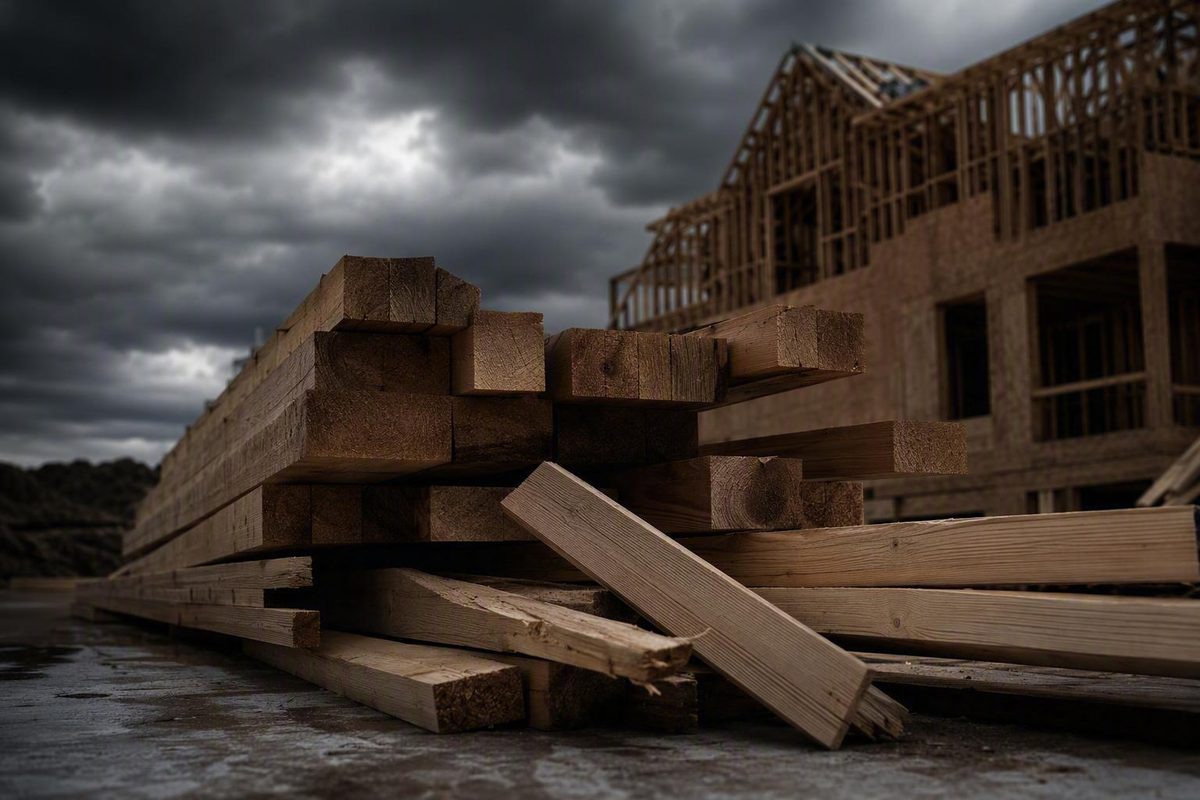
The buy-before-tariffs case has the 2026 causality backwards. U.S. housing starts fell 12.4% in July, and Madison’s framing-lumber composite stood at $558.19 per 1,000 board feet on August 7—2.6% below a year earlier—despite the 10% Section 232 tariff. Tariffs raised the cost pressure at the border, but weak construction demand erased that pressure in the market price contractors watched.
Lumber Was Cheaper Year Over Year Despite the Tariff
The decline was not universal or continuous. Madison’s index was unchanged for the week and up 2.1% for the month even as it fell 2.6% year over year. The accurate verdict is narrower: framing lumber cost less than a year earlier under this physical-market measure, while a futures-linked reference suffered a sharp late-summer retreat.
On August 28, Trading Economics displayed lumber at $565.54 per 1,000 board feet, down 10.80% over the preceding month and near a five-month low. It rose 1.08% that day and was 3.11% above its year-earlier level. Trading Economics identifies the series as a contract-for-difference tracking the lumber market, not an official physical-lumber benchmark or delivered retail quote. Trading Economics provides the market reading and methodology.
Those observations describe different market lanes and comparison periods. They nevertheless refute the claim that tariffs made an immediate price increase inevitable across the market.
Enter your project’s board feet and tariff assumption; the calculator shows which price case wins.
Framing Package Price Explorer
Convert published prices per 1,000 board feet into a project-scale comparison. The tariff rows are arithmetic scenarios, not dealer-price forecasts.
The observed framing benchmark stayed below both comparison cases despite the tariff wedge.
| Price Case | Price/MBF | 16,000-BF Package | Meaning |
|---|---|---|---|
| Madison’s, Aug. 7Observed framing index | $558.19 | $8,931 | Down 2.6% year over year; flat weekly and up 2.1% monthly. |
| Trading Economics, Aug. 28Futures-linked reference | $565.54 | $9,049 | Down 10.80% monthly but up 3.11% yearly; not a delivered quote. |
| Year-Ago ComparisonApproximate basis | ~$573.00 | ~$9,168 | Approximate basis supplied for comparing the 2.6% annual decline. |
| Year Ago + 10%Arithmetic scenario | ~$630.30 | ~$10,085 | Applies the selected uplift mechanically; it is not a transaction forecast. |
| Year Ago + ~35%Arithmetic scenario | ~$773.55 | ~$12,377 | Illustrates the upper duty arithmetic cited for Canadian softwood. |
| Gordian/RSMeans, JulyDifferent market lane | $915.88 | $14,654 | National construction-cost reference, down 2.15% year over year. |
| Your Delivered QuoteUser entry | — | — | Use only if its specification, quantity and delivery scope match the project. |
Package cost equals board feet divided by 1,000, multiplied by the selected price per 1,000 board feet. Freight, tax, panels, waste and dealer charges are not added unless included in your local quote.
Sources: Madison’s index summarized by Residential Contractor; Trading Economics lumber market reference; Gordian/RSMeans Data. ~$573 and ~10%–35% are comparison inputs from the article brief; calculated package totals are rounded.
The Buy-Before-Tariffs Argument Has a Real Basis
The received wisdom is straightforward. Canadian lumber faces a 10% Section 232 tariff, while combined duties on Canadian softwood were around 35%. Importers paying more at the border may reduce shipments or pass their costs through. Mill closures, production curtailments, freight, labor and energy expenses can reinforce the increase. Canada’s August counter-tariffs on U.S. goods including lumber add further trade uncertainty.
That case is strongest as a warning about future supply and delivered costs. Tariffs do raise landed costs, and curtailed production can leave less spare capacity if housing recovers. A contractor with a fixed schedule may rationally pay for price certainty rather than speculate on another market decline.
The argument fails when it turns that risk into a claim that market prices can only rise. By August 7, Madison’s index was lower than a year earlier with the Section 232 tariff, effective October 14, 2025, already in force. By late August, the futures-linked reference had lost 10.80% in a month even amid the expanding trade dispute. Residential Contractor reports Madison’s price and comparison periods.
The missing side of the tariff argument is demand. Trading Economics associated late-August weakness with reduced affordability, elevated mortgage rates, subdued construction spending and weaker housing activity. It reported the 12.4% July decline in housing starts as being driven by lumber-intensive single-family construction. That does not prove a one-factor causal formula, but it is directionally consistent with fewer framing packages entering production.
Tariffs set a cost wedge. They do not guarantee that weak buyers will absorb it immediately.
Three Valid Benchmarks Tell Different Stories
Prices near $558, $566 and $916 per thousand board feet appeared in credible 2026 reports. They are not competing quotes for the same lumber.
| Benchmark | Date And Price | Change | What It Measures |
|---|---|---|---|
| Madison’s | Aug. 7: $558.19 | Flat weekly; +2.1% monthly; -2.6% yearly | Framing-lumber index |
| Trading Economics | Aug. 28: $565.54 | +1.08% daily; -10.80% monthly; +3.11% yearly | Futures-linked CFD reference |
| Gordian/RSMeans | July: $915.88 | -0.08% quarterly; -2.15% yearly | National construction-cost reference |
Gordian’s national series began at $872.03 in January, down 3.44% from the fourth quarter of 2025 but up 1.50% year over year. It rebounded to $916.62 in April, a 5.11% quarterly and 4.21% annual increase. July’s $915.88 was effectively a plateau after that rebound, although its annual comparison had turned negative. Gordian publishes the RSMeans Data updates.
That sequence matters. It rules out a yearlong lumber crash: the same cost series fell, rebounded and then leveled off. It also rules out a uniform tariff-driven increase because both Madison’s and Gordian’s July readings were below their year-earlier comparisons.
Observation dates can change the answer even on one dynamic page. Trading Economics’ August 28 display showed a 3.11% annual increase, while its August 27 news entry described a 0.18% decline over 12 months. Neither figure should be detached from its observation date, and future visitors may see updated data on the commodity page.
A benchmark can reveal market direction without reproducing a project invoice. A delivered framing package may include several species, grades and lengths along with treated material, panels, engineered components, handling and freight. The approximately $558, $566 and $916 readings cannot be compared as equivalent transaction prices.
Framing Lumber Fell While Some Wood Products Rose
The evidence supports a framing-lumber thesis, not a claim about every wood product. Gordian’s July framing average was down 0.08% from the previous quarter and 2.15% year over year. During the same second-to-third-quarter interval, its plywood-product prices rose 11% and pine-board prices rose 3%.
A framing-heavy residential shell could therefore receive some relief while a plywood-heavy shear-wall, roof or formwork package became more expensive. The direction of OSB, pressure-treated lumber, engineered wood, mass-timber components and specialty products is not established by the supplied evidence.
Species, grade, length, treatment and regional availability can produce further separation. A national framing average is not a substitute for a regional quote covering long-length Douglas fir, treated southern pine or an engineered-wood schedule.
Weak Demand Can Overwhelm Import Costs
The 2026 market reflects weak demand pressing against constrained and costly supply. The July housing-starts decline helps explain why import costs did not flow mechanically into higher framing prices. Fewer single-family starts mean less immediate demand for one of construction’s most lumber-intensive packages.
Supply still limits how far prices may fall. A March industry outlook estimated North American lumber consumption declined 2.1% in 2025 and forecast only 0.4% growth in 2026 in its overview. A detailed section gave a slightly higher 0.7% figure. Its central argument was that tariffs, duties, closures, curtailments, low production and trade uncertainty could support prices despite weak consumption. Farm Credit East’s industry outlook details the demand and supply forecasts.
That creates a two-stage risk. Weak construction can depress prices while mills reduce output. If housing or remodeling improves after capacity has been removed, prices can rebound faster than they would in a market with ample production and dealer inventory.
The late-summer decline therefore does not prove that tariffs have no effect. It shows that their effect was not large enough to overcome the observed demand weakness in the framing measures cited here.
A Falling Benchmark May Not Reach the Lumberyard Immediately
A dealer may still be selling material purchased when wholesale prices were higher. A lower futures or framing index does not retroactively reduce that inventory cost.
Replacement quotes also include freight, fuel, unloading, storage, break-bulk handling, delivery, credit exposure, labor and regional availability. A decline in a common framing size may not apply to every grade and length in a package. Retailer commentary confirms the distinction between market references and local pricing, although the supplied evidence establishes no standard number of days or weeks for retail repricing. O.K. Lumber explains the wholesale-to-retail lag.
The useful comparison is a complete delivered basket with the same quantities, specifications, freight, tax treatment, substitutions and quote period. A national price per thousand board feet is a signal to refresh bids, not a promise that a particular yard will cut its price proportionally.
Published Forecasts Do Not Promise Further Declines
Trading Economics projected $569.72 per 1,000 board feet at the end of the third quarter and $614.06 in 12 months, both above its August 28 observation of $565.54. Those are model- and analyst-based estimates, not guaranteed transaction prices.
The March industry outlook separately forecast a 3.1% increase in its Framing Lumber Composite Index for 2026, primarily because of expected supply constraints. That forecast does not invalidate Madison’s observed annual decline or the late-August futures retreat. It covers a different index and time period.
Continued weakness remains plausible if single-family starts decline further, dealers reduce orders and mills discount short order files. Relative stability is plausible if mills curtail production enough to offset weak demand. Renewed increases become more likely if construction improves while mill capacity, Canadian shipments and dealer inventories remain constrained.
The published forecasts lean toward stabilization or recovery rather than a guaranteed continuing drop. The observed data through August establish only that demand had been strong enough to beat the tariff wedge so far.
Project Timing Matters More Than Tariff Headlines
For a fixed schedule, compare dated delivered quotes covering the same specification. A firm price may be worth securing when availability and schedule certainty matter more than the possibility of a later decline. Confirm the lock period, included quantities, storage terms and treatment of changes.
For a flexible schedule, monitor repeated quotes for the actual basket rather than using framing lumber as a proxy for plywood, OSB, treated lumber or engineered wood. Refreshing an expiring quote is more decision-useful than watching a financial reference alone.
| Project Position | Relevant Evidence | Practical Response |
|---|---|---|
| Fixed schedule, firm quote | Known delivered basket | Compare and consider locking |
| Fixed schedule, escalation clause | Price remains exposed | Seek a cap or defined formula |
| Flexible framing package | Madison’s and local quotes | Refresh equivalent baskets |
| Panel-heavy package | Plywood rose 11% | Track panels separately |
“Buy now before tariffs” is not supported as a universal 2026 rule. Neither is “wait because lumber will keep falling.” The defensible decision uses the project’s schedule, product mix and delivered quotes while recognizing both sides of the market: housing demand pushed framing prices below a year ago, but tariffs and reduced capacity still create rebound risk.