
PSL Beams: Specify the Member, Supports and Service Routes
Understand PSL beam sizes, grade labels, span checks, LVL tradeoffs and the bearing, drilling and moisture details that affect construction.
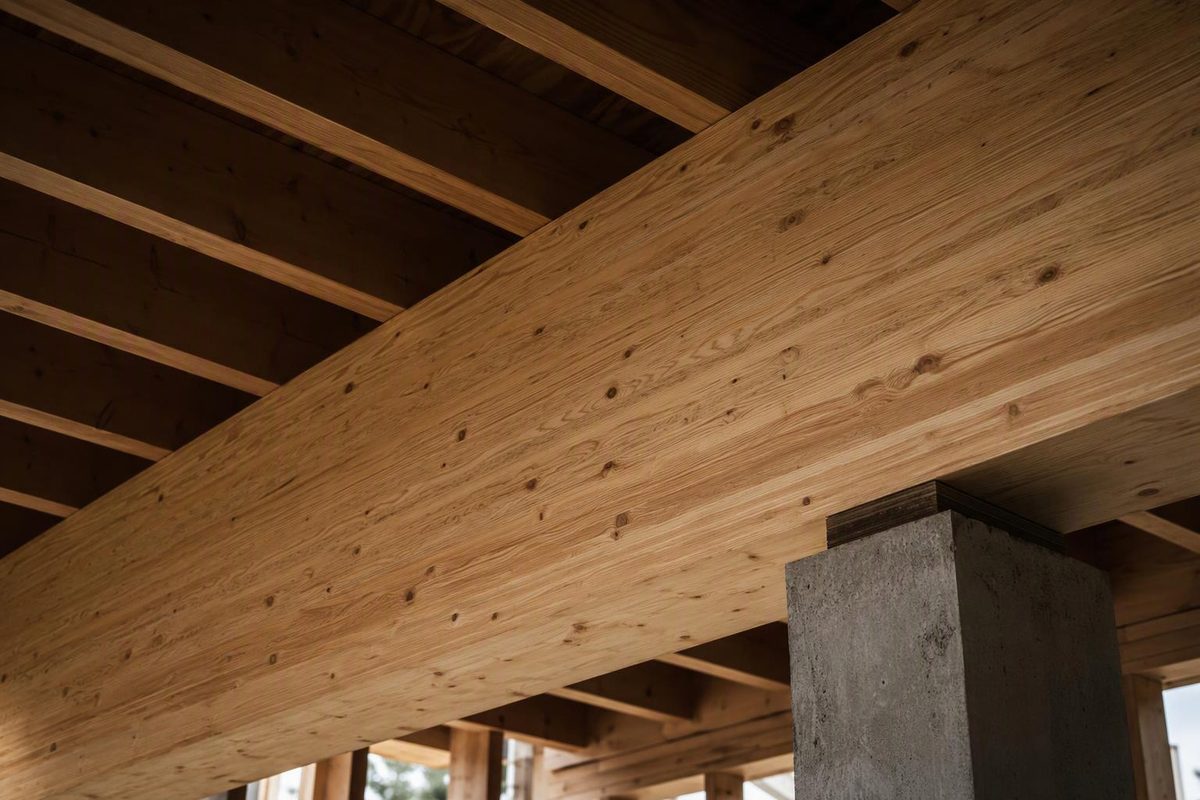
PSL beams are structural members made from parallel strand lumber: wood strands aligned along the member’s length and bonded with structural adhesive. Parallam is Weyerhaeuser’s PSL product name, not a separate material category. Its applications include beams and headers carrying floor or roof loads, with separate grades and sections available for columns. ICC-ES report ESR-1387 describes the product and its recognized structural uses.
The useful selection question is not simply “How far can PSL span?” It is whether a particular grade and cross-section can carry the project’s loads, meet deflection limits and fit the available depth—with adequate supports and connections.
PSL versus LVL: what changes on site?
PSL uses aligned strands; laminated veneer lumber, or LVL, uses bonded wood veneers. Both have product-specific structural design values, so neither material name alone establishes capacity. ESR-1387 sets out their manufacturing descriptions and reference properties.
A practical distinction is assembly. Parallam PSL is available in wide, solid sections. Microllam LVL commonly uses narrower members that can be assembled into a multi-ply beam on site. Weyerhaeuser’s beam specifier’s guide identifies reduced site assembly as a PSL benefit and reduced heavy lifting as an LVL benefit.
That is a tradeoff, not a universal cost advantage. A solid PSL section avoids inter-ply fastening, but still needs adequate bearing, restraint and designed connections where applicable. A built-up LVL beam allows separate pieces to be handled, but its ply connections must transfer loads as required—particularly where joists load one outside face. The guide provides separate multiple-member connection provisions for side-loaded and top-loaded beams.
PSL beam sizes and grade labels
As one documented U.S. regional example, Weyerhaeuser’s November 2025 Pacific Coast and Northwest guide, TJ-9020, lists these 2.2E Parallam PSL beam and header dimensions:
| Dimension | Listed sizes |
|---|---|
| Width | 3½, 5¼ and 7 inches |
| Depth | 9¼, 9½, 11¼, 11⅞, 14, 16 and 18 inches |
The guide notes that some sizes may not be available locally and directs readers to separate literature for deeper beams. These are a product range, not a span table or a guarantee of dealer stock. Use the guide for the project’s region and verify the exact product offered. Source: TJ-9020.
Write width × depth × length on the schedule. A 5¼-inch-wide beam occupies 5¼ inches before finishes or enclosure; do not substitute a nominal lumber description for its specified cross-section.
The 2.2E designation identifies a modulus of elasticity of 2.2 million psi in this guide. It is a stiffness designation, not a load rating. Bending, shear and bearing properties must also be checked. The same guide lists 1.8E PSL columns separately: a column product is not automatically interchangeable with the specified beam. Design properties, TJ-9020.
Why there is no single PSL span answer
A beam spanning an opening and carrying only a roof is a different design problem from one carrying floors, a wall above or a concentrated reaction from another beam.
Provide the designer with:
- Support geometry: clear opening, bearing lengths, support locations and any cantilever or continuous spans.
- Loading: supported floor and roof areas, dead and live loads, snow where applicable, and concentrated loads with their locations.
- Serviceability requirements: allowable live-load and total deflection, including requirements associated with finishes.
- Available envelope: maximum beam depth and width, hanger space and ceiling alignment.
- Exposure and restraint: moisture conditions and how the beam will be laterally supported.
TJ-9020’s floor tables use center-to-center bearing span, not simply the clear opening, and are based on uniform loads. They require checks of both total and live load, plus bearing adequacy. The guide’s general assumptions require lateral support at bearing and along the span at a maximum spacing of 24 inches. A beam without that restraint needs a design that addresses its actual support conditions rather than direct use of the tables. Deflection calculations must account for both bending and shear deformation. See the guide’s design assumptions and table instructions.
Increasing depth may solve a structural check while creating a dropped ceiling. Increasing width may preserve headroom but change the post, hanger and wall detail. Coordinate those consequences before ordering.
Bearing, connections and service penetrations
A satisfactory beam calculation does not establish that its supports are satisfactory. TJ-9020 requires bearing across the full beam width and gives minimum bearing lengths of 1½ inches at ends and 3½ inches at intermediate supports. Required bearing can be longer, depending on reaction and material properties. Posts, supporting framing and foundations also need to carry the resulting reactions. Bearing requirements.
For an alteration, trace those reactions to the foundation rather than stopping at the new posts; see load-bearing wall removal planning.
Do not use ordinary joist drilling rules for PSL. TJ-9020’s standard PSL hole provisions apply only within illustrated zones under uniform loading, require round holes, and prohibit holes in cantilevers or members in plank orientation. Other conditions need specific design review. Route plumbing and ducts around the beam unless an approved penetration detail is included. Allowable-hole provisions.
Moisture protection and ordering
An exterior-type adhesive does not make untreated PSL suitable for permanent weather exposure. ESR-1387 limits the products it covers to covered, dry end-use conditions with in-service equilibrium moisture content below 16%. Conditions of use.
Treated Parallam Plus PSL is a separate product. Its published warranty distinguishes above-ground beam/header applications from ground-contact column applications; “treated PSL” is not blanket permission to bury a beam. Confirm treatment, exposure limits and compatible connector specifications for the actual product. Parallam Plus product conditions.
Include lifting in procurement. TJ-9020 lists a 5¼ × 11⅞-inch PSL beam at 19.5 pounds per linear foot: a 20-foot member is about 390 pounds using that published weight. This is a handling estimate, not a lifting plan.
Request quotations against the complete schedule: product and grade, cross-section, cut length, treatment if required, connectors, delivery and unloading. Resolve the bearing, restraint and service-route details before fabrication—not after the beam arrives.