
Use Actual Lumber Sizes for Drawings and Orders
Convert nominal lumber labels to dressed dimensions with a U.S. size chart, then check rough-sawn, hardwood, moisture and regional product exceptions.
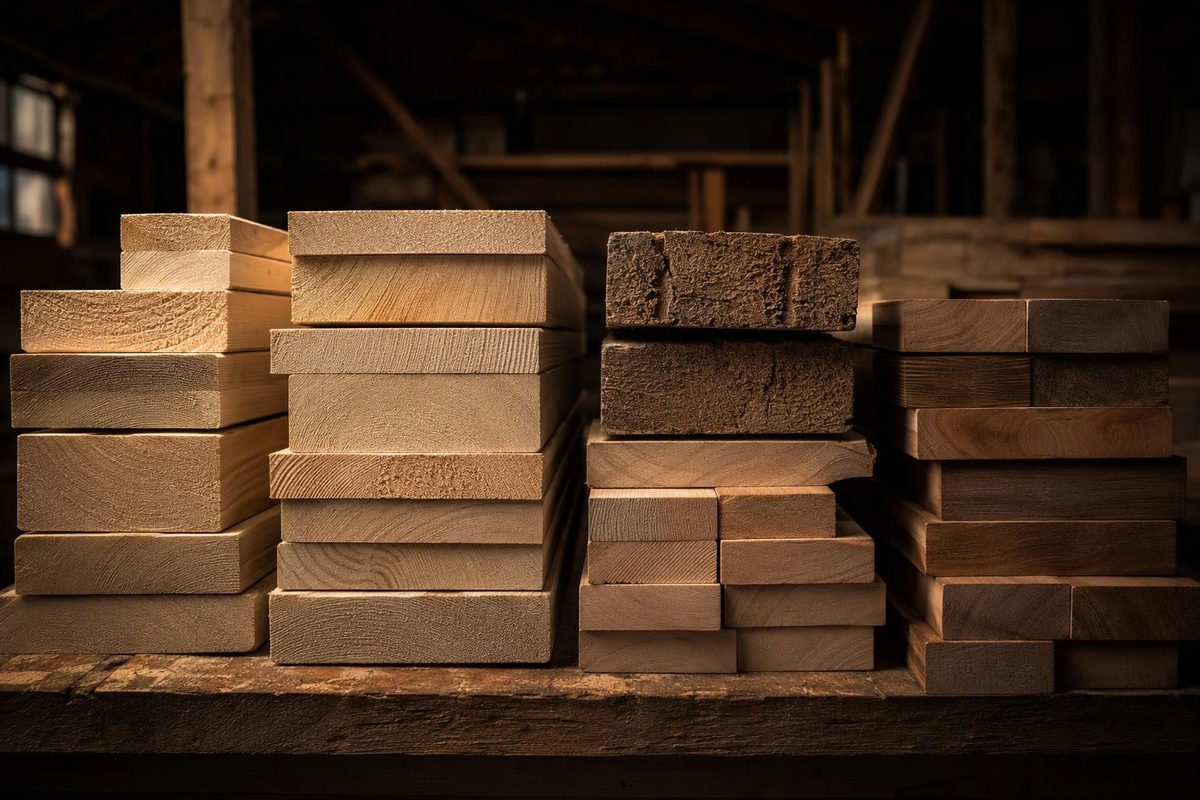
A nominal lumber measurement is a size label, not the finished cross-section. For standard U.S. dry, dressed softwood lumber, a 2 × 4 has a minimum dressed section of 1½ × 3½ inches, not 2 × 4 inches. Use the nominal label to identify the member and its dressed dimensions to coordinate wall thicknesses, openings and connections. This distinction is defined in the American Softwood Lumber Standard, PS 20-25.
The conversion depends on the product, moisture condition and market. A rough-sawn piece, a hardwood board and metric framing timber do not necessarily follow the same deductions. The lookup below applies to the standard U.S. dry, dressed softwood sizes listed—not to every product sold under a similar label.
Choose a nominal size to see its standard minimum dressed dry section.
Dry Dressed Size Lookup
2 × 4 Minimum Dressed Dry Section
1½ × 3½ in38.1 × 88.9 mmScope And Measurement Limits
Standard U.S. dry, dressed softwood cross-sections at manufacture. Not a conversion rule for rough stock, hardwood, green lumber or metric product labels. Delivered dimensions can change with moisture.
Metric equivalents are rounded to 0.1 mm. Inches are the units of record. Length is separate from these cross-section dimensions.
Source: PS 20-25, Table 3, American Softwood Lumber Standard. Without JavaScript, all inch conversions remain available in the size selector; the result panel shows 2 × 4.
U.S. Nominal-To-Actual Lumber Size Chart
These are standard minimum dressed dry cross-sections at manufacture, drawn from Table 3 of PS 20-25. They are the usual reference dimensions for U.S. boards, dimension lumber and the timber sizes shown—not a guarantee that every delivered piece will measure identically.
| Nominal Size, Inches | Dressed Dry Size, Inches | Metric Equivalent, mm* |
|---|---|---|
| 1 × 4 | ¾ × 3½ | 19.1 × 88.9 |
| 1 × 6 | ¾ × 5½ | 19.1 × 139.7 |
| 1 × 8 | ¾ × 7¼ | 19.1 × 184.2 |
| 2 × 2 | 1½ × 1½ | 38.1 × 38.1 |
| 2 × 4 | 1½ × 3½ | 38.1 × 88.9 |
| 2 × 6 | 1½ × 5½ | 38.1 × 139.7 |
| 2 × 8 | 1½ × 7¼ | 38.1 × 184.2 |
| 2 × 10 | 1½ × 9¼ | 38.1 × 235.0 |
| 2 × 12 | 1½ × 11¼ | 38.1 × 285.8 |
| 4 × 4 | 3½ × 3½ | 88.9 × 88.9 |
| 6 × 6 | 5½ × 5½ | 139.7 × 139.7 |
*Metric equivalents are rounded to 0.1 mm; inches are the units of record in the standard. Source: PS 20-25, Table 3.
For the common 2-inch-thick framing sizes, subtract ½ inch from the nominal thickness. Subtract ½ inch from widths of 2, 4 and 6 inches, but ¾ inch from widths of 8, 10 and 12 inches. “Subtract half an inch from everything” is not a reliable rule. The 1-inch-nominal boards in the chart also finish at ¾ inch thick, so that shortcut fails for their thickness as well.
Read both dimensions independently. A 2 × 8 uses the same dressed thickness as a 2 × 4, but its width follows the larger-width deduction. A square designation does not imply a full nominal square: the listed 4 × 4 and 6 × 6 sizes are smaller in both directions.
The metric column converts these U.S. sections; it does not identify the nearest locally stocked metric product. For a detail drawn in millimetres, use the converted dimensions only when the specified material is the corresponding U.S. product. Otherwise, obtain the supplier’s finished section before selecting a substitute.
Nominal Length Does Not Use The Cross-Section Deduction
Length is treated separately. Under PS 20-25’s ordinary trimming rule, standard 2-inch-nominal lumber is not shorter than its nominal length and may be supplied overlength, unless the purchase contract states otherwise. Do not apply the cross-section deductions to an 8-foot length; confirm special precut-stud lengths separately. PS 20-25, §5.3
On an order, distinguish the stock length from the final cut length required by the detail. A member can have the correct nominal cross-section and still need trimming to fit. Conversely, a precut product should be checked against its stated length rather than assumed to match an ordinary stock-length description.
This separates two coordination tasks: the actual cross-section determines how the member fits across a wall, opening or connector, while the required length determines where its ends land. Writing only the nominal designation leaves the latter unresolved.
Rough-Sawn Lumber Is Not Necessarily Full Nominal Size
Dressed or surfaced lumber has been machined for smoothness and dimensional uniformity. S4S means surfaced on four sides; S2S means surfaced on the two broad faces. Surfacing removes wood, while drying can also reduce the cross-section. The nominal designation remains the size category rather than becoming a measurement of the finished piece.
Rough-sawn does not automatically mean full nominal size. PS 20-25 bases minimum rough sizes on the corresponding dressed sizes plus a machining allowance—not on a requirement that every rough 2 × 4 measure exactly 2 × 4 inches. It also recognizes saw-sized lumber that retains a rough texture at dressed dimensions. PS 20-25, §§2–3 and 5.1–5.2
Surface texture and cross-section therefore answer different questions. “Rough” describes a condition of the material; it is not enough to establish the exact section available for a tight-fit joint or an exposed member. Likewise, S2S identifies which faces have been surfaced, but does not by itself give every finished dimension needed for a detail.
If a detail needs a true 2 × 4-inch section, order that actual cross-section explicitly rather than relying on “rough.” Ask the supplier to confirm the dimensions and surface condition together. That avoids receiving material with the intended appearance but the wrong section, or the intended section with an unsuitable finish.
Do not use the dry, dressed chart as a machining schedule for unspecified rough stock. The chart identifies the standardized finished sections shown; it does not establish how much usable wood an individual rough piece will provide after the required surfacing.
Dry And Green Lumber Have Different Minimum Sections
Moisture condition matters. For lumber less than 5 inches in nominal thickness, “dry” means no more than 19% moisture content; larger timbers follow the applicable grading rules. A standard green dressed 2 × 4 has a larger minimum section—1 9/16 × 3 9/16 inches—with species exceptions. Dimensions can change after manufacture as moisture changes. PS 20-25, §2.7 and Table 3
That green 2 × 4 example should not be turned into a universal adjustment for every size or species. It establishes why the moisture category belongs alongside the nominal size when checking a section. The dry chart and a green product description are not interchangeable specifications.
The phrase “at manufacture” also matters when inspecting delivered lumber. The chart is a reference for the standard’s manufacturing dimensions, not a promise that a piece will retain an identical measurement through every later moisture condition. A field measurement and a standardized size label describe different aspects of the same member.
Where a connection or finish detail depends on a close fit, confirm the supplied section and moisture condition before finalizing the mating parts. Do not resolve a mismatch by assuming that the nominal label is the physical measurement or that every green member will finish at the chart dimensions without qualification.
Hardwood Quarter Sizes Follow Another Convention
Hardwood stock uses another convention. In the American Hardwood Export Council’s grading guide, 4/4 denotes 1-inch rough thickness and 8/4 denotes 2-inch rough thickness. Its standard surfacing deductions produce 13/16-inch and 1¾-inch finished thicknesses respectively.
These quarter designations describe rough thickness categories; they are not the same naming system as the softwood framing chart. In particular, treating 4/4 hardwood as equivalent to a ¾-inch softwood board would obscure the different finished thicknesses stated in the guide.
For joinery, specify the required finished thickness rather than leaving it to the quarter label. Keep the stock designation in the order where it helps identify the material, but make the dimension needed by the assembly explicit. A cabinet part, trim piece or joint is coordinated to its finished section, not merely to the name of the rough stock from which it is made.
The hardwood example is also a reason not to publish a single deduction for all “nominal lumber.” A conversion that correctly identifies a dressed softwood framing member can give the wrong answer when applied to hardwood stock.
Metric Product Labels Need Their Own Finished Dimensions
Metric numbers can still be nominal. In the United Kingdom, Travis Perkins lists BSW CLS timber as 50 × 100 mm, while explicitly stating a 38 × 89 mm finished size. For that product, the larger numbers in the title are not the section to draw. Supplier specification
In Australia, do not subtract U.S. inch allowances from a metric product specification. Mitre 10 lists a 90 × 45 mm treated-pine product with cross-sectional dimensions of 90 and 45 mm. That section is not interchangeable dimensionally with a U.S. 2 × 4, which is approximately 89 × 38 mm. Supplier specification
These are product-specific examples, not universal conversion rules for either country. The UK listing demonstrates a nominal metric label paired with a smaller finished section. The Australian listing demonstrates a product whose stated cross-sectional dimensions match the listed metric size. Neither establishes how every supplier in that market labels timber.
When moving a detail between markets, compare finished thickness and width rather than searching only for a familiar trade name. A product that appears to occupy the same framing category can still alter wall thickness or connector fit. Use the supplier’s finished dimensions in the drawing and retain the product designation in the specification so the two remain traceable.
Actual Sections Determine Wall Thickness And Fit
Consider a simple partition with 2 × 4 studs and ½-inch lining on each face. Its overall thickness is 3½ + ½ + ½ = 4½ inches, excluding other layers.
Drawing the stud as 4 inches thick would make that same wall 5 inches thick—a ½-inch coordination error affecting jamb depths, returns and adjacent clearances. The nominal label can remain “2 × 4 studs” in the specification, while the drawn assembly uses the actual stud thickness.
Keep the material designation and the geometric dimension separate in details. The designation identifies what is being ordered; the dimension establishes the space it occupies. Where other layers are present, add their specified thicknesses rather than treating the simple partition example as a complete wall assembly.
The same distinction applies at connections. Check the actual member section against the required fit, and do not assume that matching nominal labels alone establishes compatibility. A proposed substitution should be reviewed against the finished dimensions used in the detail, not just against the name of the original member.
Orders Need More Than A Nominal Size
Before ordering or accepting a substitution, record the nominal designation and actual required section, especially for tight-fit details. State the surface condition—rough, S2S or S4S—and the moisture condition, dry or green. Identify the stock length and any required final cut length separately.
Include the species or species group, structural grade and treatment where applicable. Those requirements remain necessary even when the supplied dimensions match the drawing. A dimensional match resolves fit; it does not establish structural equivalence.
Size alone does not establish load capacity: PS 20-25 defines structural design values for specific grades and species or species groups. Manufactured components such as I-joists and trusses fall outside the standard’s scope, so this chart is not their sizing rule. PS 20-25, §§1.1.3 and 2.6 For that distinction, see floor trusses versus floor joists.
For the sizes covered here, the working sequence is straightforward: identify the product category, confirm its surface and moisture conditions, and use the applicable finished section. Where the supplier’s specification does not provide that section, ask for it rather than extending the U.S. dry-softwood deductions to an unknown product.