
How Much Does a Cinderblock Weigh?
Compare sourced 8×8×16 concrete block weights, calculate pallet loads, and distinguish individual block weight from finished masonry wall weight.
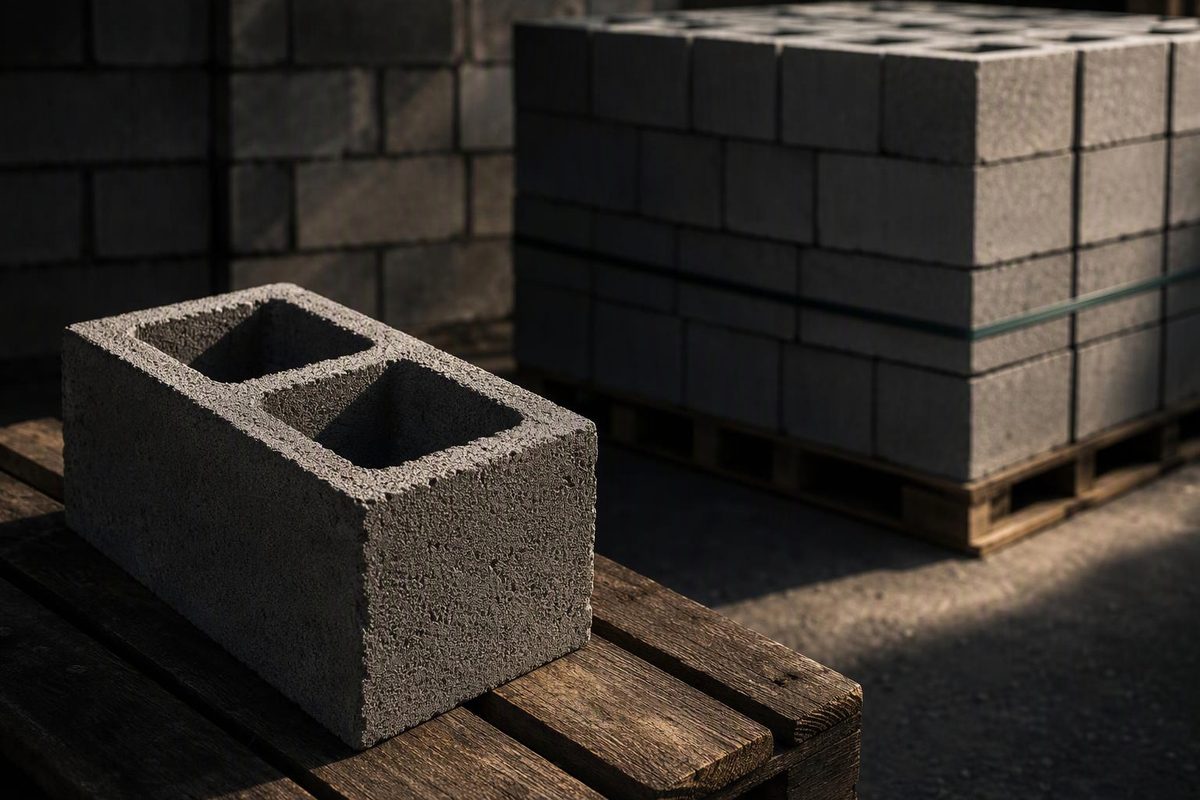
Published examples of hollow 8 × 8 × 16-inch concrete blocks weigh 35–40 lb (about 16–18 kg) in standard mixes—not a universal specification. Tileco lists its standard-mix unit at 35 lb; Amcon lists its smooth-face or burnished standard-weight cored unit at 40 lb. Lightweight, solid and specialty units require different figures. (Tileco unit data, Amcon technical guide, delivery data)
For purchasing, lifting or load calculations, identify the actual concrete masonry unit (CMU), rather than relying on the name “cinderblock.” Its size alone does not establish its weight.
Published block weights
These are specific manufacturer examples, not industry-wide weight ranges. Dimensions are nominal and listed as width × height × length. Kilogram values are rounded conversions.
| Unit | Manufacturer | Published weight | Approximate mass |
|---|---|---|---|
| 8 × 8 × 16 standard mix | Tileco | 35 lb | 15.9 kg |
| 8 × 8 × 16 cored, standard weight, smooth-face or burnished | Amcon | 40 lb | 18.1 kg |
| 8 × 8 × 16 cored, lightweight, smooth-face or burnished | Amcon | 32 lb | 14.5 kg |
| 8 × 8 × 16 solid, smooth-face or burnished | Amcon | 73 lb | 33.1 kg |
| 8 × 8 × 16 lintel | Tileco | 42.5 lb | 19.3 kg |
| 8 × 8 × 8 half-length unit | Tileco | 19.5 lb | 8.8 kg |
Sources: Tileco’s 8-inch unit schedule and Amcon’s delivery tables. Amcon labels its figures unit dry weight; Tileco’s schedule does not state a moisture basis.
The distinction between hollow and solid is especially important: Amcon’s solid example weighs almost twice its standard-weight cored example. Also, a “double solid end” block is not necessarily a completely solid block—Tileco lists that configuration at 36 lb.
Why the same nominal size weighs differently
A nominal 8 × 8 × 16-inch block typically has specified dimensions of 7⅝ × 7⅝ × 15⅝ inches. The difference accommodates the usual ⅜-inch mortar joints in modular layout. Use nominal dimensions for coursing, but do not multiply the nominal outside volume by concrete density to estimate a hollow unit’s weight: that would count its empty cells as concrete. (CMHA sizes and configurations guidance)
Three variables explain most differences:
- Concrete density. Aggregate selection changes the density of the concrete forming the block. “Lightweight” describes a density classification, not a fixed number of pounds per unit.
- Concrete volume. Face-shell thickness, webs, open ends and solid bottoms change how much concrete occupies the same outside dimensions. Lintel units, for example, have a solid bottom to contain grout.
- Moisture. Concrete masonry absorbs water, so an oven-dry or published dry weight should not be assumed to equal the weight of a wet block.
CMHA describes these density, configuration and absorption effects in its unit-properties guidance. A lower-weight unit is not automatically nonloadbearing or weaker: density and specified compressive strength are separate properties.
Calculate the shipment, not just the block
For one product:
Estimated shipment weight = block count × unit weight + pallet and packaging weight
Using Amcon’s standard-weight cored example:
- 75 blocks × 40 lb dry weight = 3,000 lb of blocks.
- Add the guide’s 50 lb pallet allowance.
- Total published cube weight = 3,050 lb, approximately 1,383 kg. (Amcon delivery data)
Pallet counts vary by supplier and product. Tileco lists 108 standard-mix blocks per pallet: 108 × 35 lb gives 3,780 lb of blocks alone, before the pallet or packaging. (Tileco schedule)
For a mixed order, calculate each unit type separately. Confirm the supplier’s gross shipment weight before arranging transport, and check it against the vehicle or handling equipment’s applicable capacity rather than judging by available space.
Block weight is not finished wall weight
A wall includes units, mortar, reinforcement, grout and any finishes. Grouting increases the installed weight; a calculation using only hollow-block weights omits that material. (CMHA assembly-property guidance)
Keep shipment weight and wall dead load as separate calculations. For foundation or supporting-member design, use the specified assembly and grout layout—not a generic pounds-per-block estimate. The CMU wall design and detailing guide explains how reinforcement, openings and assembly details fit together.