
Why Cellar Timber Rots—and How to Trace the Damp Behind It
Trace leaks, groundwater, rainwater defects, condensation and damp-masonry connections, with a table showing where to check first.
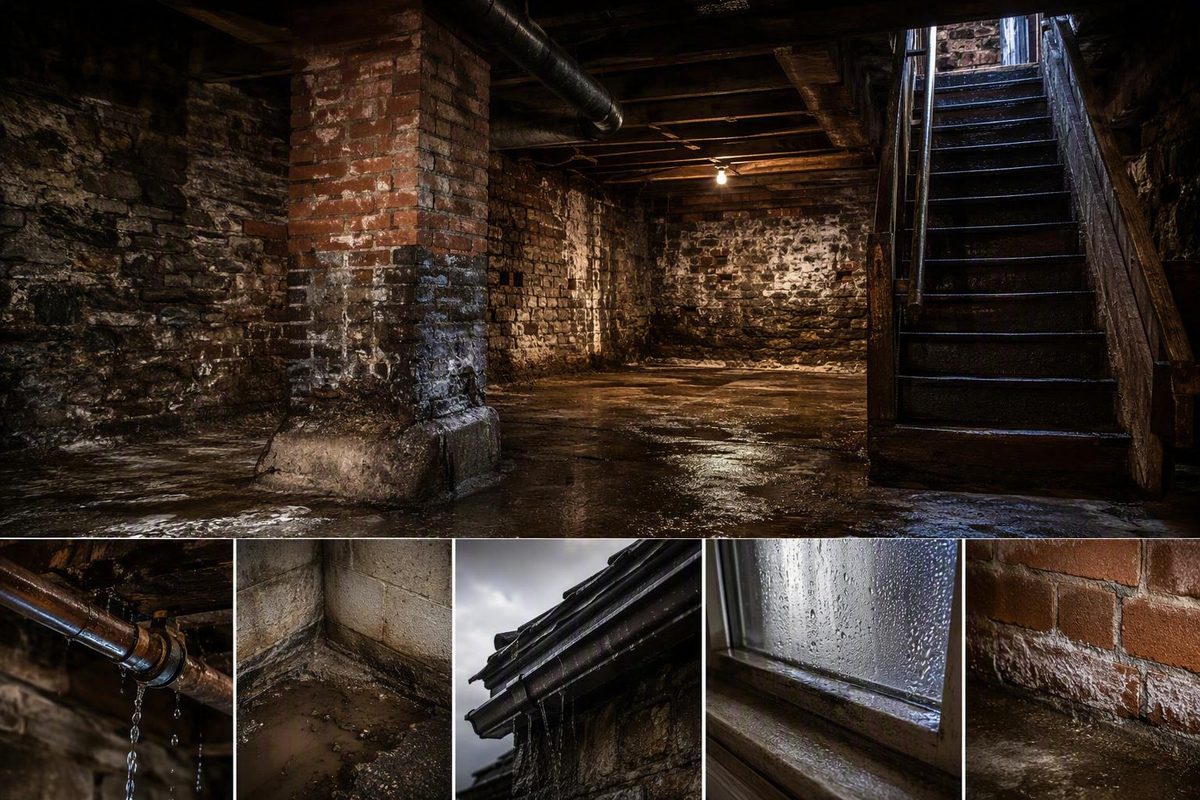
Cellar dry rot develops when timber becomes damp and cannot dry promptly. True dry rot is fungal timber decay associated with Serpula lacrymans; despite the name, moisture is required for it to become established. The correct response is to trace and stop the water pathway, promote appropriate drying, identify uncertain decay, and assess whether affected structural timber retains adequate strength. Guidance on dry and wet rot identifies moisture as essential to fungal establishment.
The short answer: persistent moisture starts cellar dry rot
The usual causal chain is:
- A leak, damp wall, wet floor, groundwater route, condensation, or elevated humidity introduces moisture.
- Restricted evaporation keeps the timber damp.
- Fungal spores germinate under suitable conditions.
- Fungal growth breaks down the wood and progressively weakens it.
The root cause is sustained timber moisture. Poor airflow, cool surfaces, enclosed voids, impermeable finishes, stored materials, and concealed construction contribute because they slow drying or hide wet areas. They do not cause fungal decay in genuinely dry timber by themselves.
Duration matters. A brief wetting event that is discovered and dried promptly is less concerning than repeated leakage or persistent dampness. A small pipe seepage can therefore be more damaging than a conspicuous spill if it continually feeds a joist end inside a wall.
Cellars combine several unfavorable features. They sit partly or wholly below ground, are commonly bounded by moisture-prone masonry, and may contain timber at wall junctions, floor edges, stair bases, or behind finishes. Joist ends, beam pockets, sill plates, and subfloors can remain damp after the visible room surface appears dry.
The term “dry rot” describes the eventual character of the damaged timber, not the condition in which decay begins. Affected wood may become brown, brittle, shrunken, and crumbly, but the process starts with moisture.
Cellar moisture sources: a cause-to-check decision table
The first task is not to name the fungus. It is to determine how moisture is reaching the timber and why it remains there. The table below provides prompts for choosing what or whom to investigate; it is not a validated test sequence and cannot prove which fungus is present.
| Moisture pathway | Likely cellar locations | Clues to check | First corrective investigation |
|---|---|---|---|
| Leaking supply or heating pipe | Below pipe runs, around clips and penetrations, near boilers or tanks | Local staining, corrosion, intermittent droplets, damp unrelated to rain | Have the pipe run, joints, valves, and equipment checked |
| Leaking waste pipe or failed drain | Below kitchens or bathrooms, beside soil stacks, beneath floors | Odor, staining around joints, damp after appliance use, water under floors | Inspect accessible connections; use a drainage specialist for concealed testing |
| Blocked or broken below-ground drainage | Floor edges, drain routes, wall bases, subfloor voids | Persistent wetness, backed-up water, damp after heavy use or rain | Establish the drain route, condition, and discharge point |
| Failed heater, pump, or appliance | Plant areas and adjoining floor assemblies | Overflow marks, corrosion, previous flood line, recurring puddles | Check equipment, trays, pumps, relief pipes, and discharge arrangements |
| Blocked or leaking gutter | External wall below the defect, joist ends, beam pockets | Saturated masonry after rain, exterior streaking, overflowing eaves | Observe rainwater disposal during rainfall and inspect the gutter |
| Defective or badly routed downpipe | Foundation wall, cellar corner, window well | Damp near the outlet, ponding, or erosion outside | Confirm where the pipe discharges and whether water is carried away |
| Poor grading or raised exterior ground | Wall bases, low vents, sill plates, embedded joists | Ground slopes toward the building or bridges openings | Compare exterior levels with vulnerable walls, vents, and internal floors |
| Flooded or poorly drained window well | Window framing, wall below, nearby floor structure | Debris, standing water, tide marks, storm-related leakage | Inspect the well, drain, cover, and connection to site drainage |
| Groundwater or foundation-wall intrusion | Below-grade walls, cracks, wall-floor junctions | Seasonal seepage, mineral deposits, damp bands, active water entry | Record where and when water appears; obtain building or drainage advice |
| Capillary moisture | Wall bases, sleeper walls, sill plates, timber built into masonry | Continuous dampness rising from soil, slab, footing, or wet masonry | Investigate continuity between the ground, masonry, and timber |
| Damp masonry or beam pocket | Embedded joist ends and concealed bearings | Decay concentrated at the end of an otherwise drier member | Have the junction exposed where necessary and appropriate |
| Timber touching wet concrete, soil, or walls | Posts, partitions, sleepers, sill plates, stair-stringer bases | Decay concentrated at the contact face | Assess whether separation, drainage, or redesign is required |
| Condensation or high humidity | Cool walls, pipes, subfloors, crowded storage areas | Surface droplets, seasonal dampness, widespread moisture without a discrete leak | Examine moisture generation, cool surfaces, and air movement |
| Restricted drying | Behind linings, under floors, in filled pockets, beside stored goods | Damp persists after the initial event; little timber is exposed to air | Ask an appropriate professional to open representative concealed areas if needed |
Several pathways can overlap. A faulty downpipe may saturate masonry, which then wets an embedded joist. Raised ground can direct rainwater toward a low opening while obstructing ventilation. Condensation may coexist with groundwater entry rather than being the sole cause.
Follow the pattern beyond the visible patch. If one end of a beam is wetter than the exposed span, investigate the bearing pocket and the opposite side of the wall. If damp follows a pipe route, examine that route above and beyond the damaged area. Apparently isolated decay may continue into concealed construction.
Why poor ventilation raises the risk without being the root cause
Poor ventilation is usually a risk multiplier, not the originating defect. Air movement can assist evaporation, while stagnant conditions allow elevated humidity and timber moisture to persist. This matters especially around embedded timber, behind linings, beneath floors, and in storage-packed cellars.
Opening windows can make matters worse when warm, humid outdoor air meets cool cellar surfaces. The University of Minnesota explains this summer condensation pathway. Choose ventilation or dehumidification for the actual conditions.
Supplying more air is not equivalent to stopping water. Ventilation cannot compensate for an active plumbing leak, saturated foundation wall, broken drain, or repeated groundwater entry. A dehumidifier may reduce moisture in the cellar air while leaving a joist end continuously supplied by wet masonry.
Condensation is different because it can itself provide moisture. Moist air meeting a sufficiently cool cellar surface may deposit water even when no pipe or foundation leak is visible. Timber beside cool walls, pipes, or stagnant corners may consequently remain damp.
Cellars are vulnerable because they are enclosed and below grade, often bordered by damp or cool masonry. Structural timber may also be hidden behind plaster, ceilings, floors, or stored materials, allowing the visible room to dry faster than concealed bearing points.
There is no universal prescription for ventilation, heating, dehumidification, drainage, or waterproofing. The appropriate response depends on the source, season, construction, and intended use of the cellar. The useful distinction is:
- Source control stops water entering or being generated.
- Drying measures remove moisture already present.
- Environmental control reduces the chance of moisture remaining trapped.
- Construction repairs correct defective details or separate timber from damp materials.
A durable repair may require several of these measures, but airflow improvements should not distract from locating the water source.
What a moisture reading can—and cannot—tell you
Approximately 20% timber moisture content is commonly cited as a warning level at which fungal-decay risk warrants investigation. It is not a universal safe-versus-unsafe boundary and does not prove that dry rot is active. Published figures vary, with some guidance describing attack near 22% when the affected timber is connected to a wetter source and more favorable growth at higher moisture levels. Specialist surveying guidance summarizes the reported variation in moisture conditions associated with Serpula lacrymans.
One reading cannot:
-
identify Serpula lacrymans;
-
show the full extent of decay behind finishes;
-
determine whether a structural member remains adequate.
Readings are most useful as a comparative map. Look for wetter and drier areas, then ask what connects the pattern to plumbing, rainwater disposal, exterior ground, damp masonry, groundwater, or condensation. A damp cluster around one joist pocket suggests a different pathway from elevated readings throughout an exposed subfloor.
Interpret readings alongside the building details and visible condition. Risk also depends on how long wetting has persisted, whether drying is restricted, the condition of the timber, and whether the measured area is connected to a wetter reservoir.
A reading below a commonly quoted warning level should not override clear evidence of existing decay. Conversely, a high reading establishes the need to investigate moisture; it does not identify the fungus or dictate a particular treatment.
True dry rot versus wet rot and brown cellar rot
Not every cellar fungus is true dry rot. “Rot,” “brown rot,” “wet rot,” and “dry rot” are sometimes used loosely, but they are not interchangeable diagnostic labels.
| Finding or category | What it generally means | Typical behavior | Diagnostic limitation |
|---|---|---|---|
| True dry rot | Timber decay associated with Serpula lacrymans | Establishes in damp conditions; strands may extend across damp masonry or plaster toward other timber | Appearance alone cannot confirm the species |
| Wet rot or brown cellar rot | Decay associated with persistent local wetness; brown cellar rot is linked to Coniophora puteana | Commonly remains associated with the wet area and is more sensitive to drying | Cuboidal decay and strands may resemble other fungi |
| Damp, mould, or mineral signs | Surface growth, staining, deposits, or odors indicating moisture | May occur without structural timber decay | Does not establish that a wood-decay fungus is present |
Coniophora puteana is a distinct wet-rot species commonly called brown cellar rot or cellar fungus. Its strands may begin pale and later turn black, but black strands are only a possible feature—not a field identification test. A description of brown cellar rot distinguishes it from true dry rot and notes the changing color of its strands.
True dry-rot strands may travel over or through damp porous masonry, mortar joints, or plaster while seeking timber. This does not mean the fungus consumes brick, stone, plaster, or concrete. Masonry provides a route or moisture-connected substrate; timber is the material undergoing decay.
Wet rot is more commonly concentrated around persistently wet wood, such as a leaking pipe penetration or a beam end in saturated masonry. That general behavior can guide investigation, but concealed construction, previous repairs, and multiple water sources can obscure the pattern.
Color, odor, cracking, dust, or photographs cannot reliably confirm species. Expert fungal identification is appropriate where the answer would change the extent of opening-up, timber repair, or other remedial work.
Warning signs and the correct order of response
Signs that justify investigation include:
- brown timber that is brittle, crumbly, or shrunken;
- cuboidal or block-like cracking;
- white or grey cotton-like mycelium;
- fungal strands over wood or adjacent surfaces;
- orange-brown or rust-toned fruiting bodies;
- rust-red spore dust;
- blackened strands that may indicate brown cellar rot;
- a persistent musty or mushroom-like odor;
- local floor movement, sagging, or distortion near damp timber.
These signs are suggestive rather than conclusive. Several fungi can produce similar decay, while staining, dust, and odor may have other causes.
If a floor is sagging, moving, or visibly unstable, keep people and added loads away from the affected area and arrange a structural assessment before entering beneath it or opening up the construction.
Once access is safe, inspect in this order:
- Look for active water entry. Check pipes, wastes, drains, equipment, gutters, downpipes, window wells, wall-floor junctions, and rain-related or seasonal patterns.
- Inspect vulnerable details. Prioritize joist ends, beam pockets, sill plates, subfloors, stair-stringer bases, pipe penetrations, and wood-to-masonry or wood-to-soil contacts.
- Trace concealed connections. Follow strands, staining, and moisture patterns into adjoining voids. Intrusive opening-up should be planned by an appropriate building professional where services, structural elements, or concealed materials may be involved.
- Determine the extent of decay. Do not assume that the visible edge is the limit, but do not apply an arbitrary removal distance.
- Assess residual strength. Visual signs alone cannot establish whether joists, beams, posts, plates, or bearing ends remain structurally adequate.
The repair sequence is equally important: stop the moisture source, promote drying suited to the construction, identify uncertain fungal decay, assess the remaining timber, and only then specify repair, reinforcement, or replacement.
Removing surface growth, painting over stains, or replacing a small visible patch without correcting the damp condition leaves the cause in place. Fungicide, masonry treatment, waterproofing, or dehumidification may form part of a project-specific response, but none is a universal substitute for diagnosis and moisture control.
Stopping a leak also does not restore strength already lost. Sagging floors, weakened joists or beams, soft bearing ends, and decay at load-bearing points require prompt site-specific structural assessment rather than a judgment based only on appearance. Structural weakening of beams and joists is the principal safety concern associated with advanced timber decay. This cellar dry-rot guide identifies weakened beams, joists, and other structural timber as key concerns.
Specialist assessment is also appropriate when the fungus is uncertain, decay disappears behind finishes, or several moisture pathways may be involved. Depending on the cause and affected construction, the investigation may require a structural engineer, building surveyor, plumber, drainage specialist, or conservation professional.