
What Is Limestone Used For? From Facades to Cement
Limestone is used for building stone, road base, concrete aggregate, cement and lime. Learn how its form and properties affect specification.
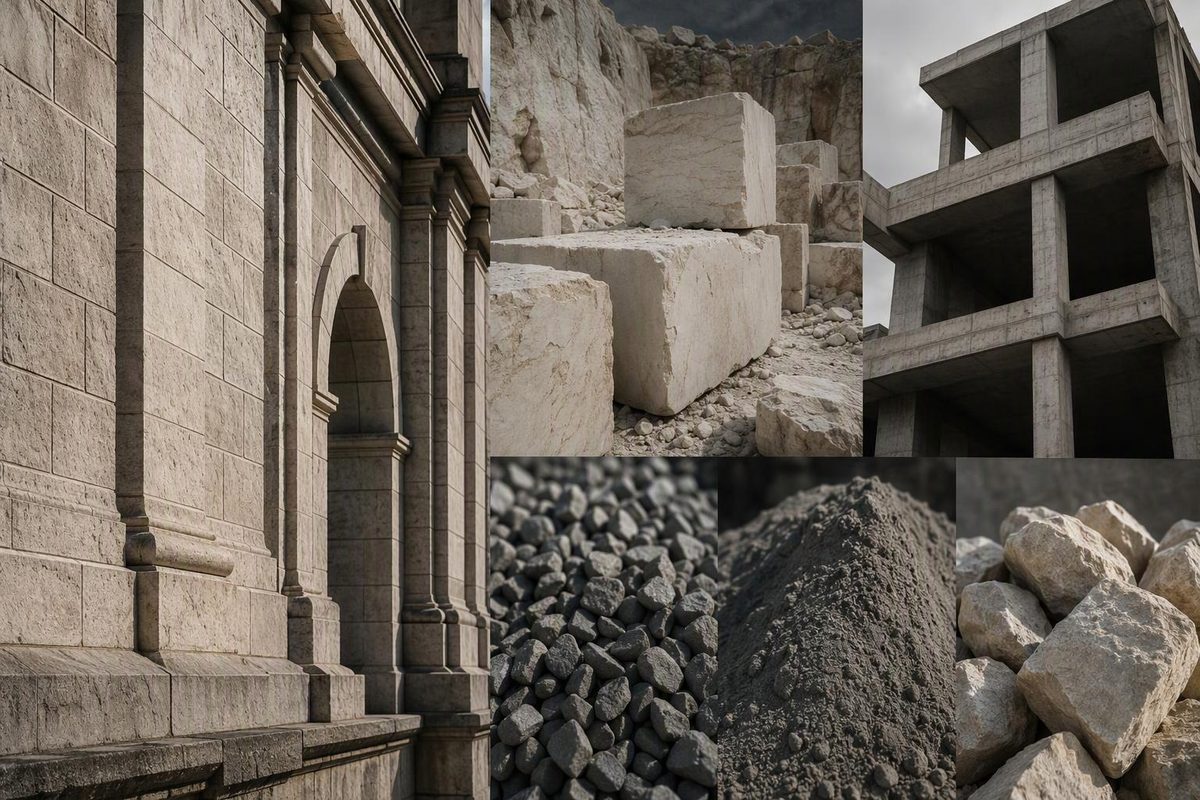
Limestone is used as cut building stone, crushed aggregate, a raw material for cement and lime, and a mineral filler. Outside construction, it also serves agriculture, metal production and pollution control. These uses depend on two different qualities: the physical properties of the rock and the chemistry of its calcium carbonate. The U.S. Geological Survey’s limestone fact sheet describes both.
For a building project, the first distinction is its form. A limestone facade panel, a truckload of crushed limestone and a bag of hydrated lime are not interchangeable products.
Cut limestone: facades, masonry and architectural details
Limestone can be sawed, split or carved into dimension stone—pieces manufactured to specified sizes and shapes. It is used for exterior cladding and shaped architectural features such as moldings and statuary. Its relative softness makes intricate carving practical, while its earth tones suit both interior and exterior work. The Natural Stone Institute’s limestone guide documents these applications.
The stone’s role must be clear on the drawings. A cladding panel needs a support and attachment system; describing it as “limestone” does not establish how it carries its own weight or transfers applied loads. ASTM C1242-23, the guide for dimension-stone attachment systems, addresses gravity and applied loads and requires compatibility between stone, supports and adjoining building systems.
For U.S. specifications, ASTM C568/C568M-22 covers limestone dimension stone for general building and structural purposes. It classifies stone into low-, medium- and high-density categories and includes requirements for absorption, density, compressive strength, modulus of rupture and abrasion resistance. It specifically excludes crushed stone and molded or cast units made from stone fragments.
Flooring, paving and countertops need different checks
A stone suitable for a vertical facade is not automatically suitable for a patio or heavily trafficked floor. For flooring, review abrasion resistance and slip performance as well as strength and support conditions; the Natural Stone Institute’s testing guidance explains why application-specific testing matters.
Exterior paving deserves particular scrutiny in freezing climates. The institute notes that relatively few limestone varieties have a successful history as exterior paving, especially under freeze–thaw exposure. It also reports substantial variation in absorption between varieties. Ask for evidence relevant to the proposed exposure, not simply photographs of a successful limestone wall. See its limestone selection guidance.
Countertops are possible, but acid sensitivity and absorption limit suitable varieties. Lemon juice, vinegar and acidic cleaners can dull or etch calcium-carbonate stone. Use mild, non-acidic cleaning products; an impregnating sealer may improve stain resistance, but does not make stone stain-proof. See the institute’s limestone selection and care guidance.
Crushed limestone: aggregate, road base and landscaping
Crushed limestone is used as aggregate in concrete and asphalt, as road aggregate, and as decorative landscaping stone. In these applications, the rock remains a granular material rather than becoming a cementitious binder. USGS identifies these uses.
For pavement base, the important properties include particle size distribution, shape, durability and fines content. Angular particles and suitable grading contribute to stability; grading also influences permeability. The Federal Highway Administration’s granular-base guidance explains these relationships.
The practical consequence: do not specify “crushed limestone” alone. Identify the required grading and performance. A dense-graded base and a drainage aggregate have different jobs, even if both come from the same quarry. Decorative stone selected for appearance should not be assumed to meet an engineered base specification.
Cement and lime: limestone is chemically processed
Limestone supplies calcium for cement manufacture. It is combined with other raw materials and heated at high temperatures, then processed into cement. Cement mixed with water forms the paste that binds sand and rock in concrete, as the American Cement Association explains.
Limestone also supplies the raw material for lime:
- Quicklime is produced by heating limestone, releasing carbon dioxide, as the National Lime Association’s production guide explains.
- Hydrated lime is manufactured by reacting quicklime with water. The association’s terminology guide distinguishes these products from limestone.
Hydrated lime is used in masonry mortars, stuccos and plasters; lime is also used for soil stabilization. These are uses of a manufactured lime product, not untreated crushed limestone. The National Lime Association describes these construction applications.
Other uses: agriculture, fillers and industrial treatment
Ground limestone can neutralize acidic soil. The application amount should follow a soil-test recommendation and account for the material’s neutralizing value and fineness, according to Penn State Extension.
Limestone is also used as a filler in paper, plastics and paint, to remove impurities from molten metals, and to remove pollutants from coal-burning power-plant exhaust. High-purity grades have food and medicine applications. These uses require appropriate processing and purity; ordinary construction aggregate is not a substitute for a controlled industrial or food-grade product. USGS describes this wider range of applications.
On a specification or purchase order, name the product form, intended use and required properties—not just the rock type.