
Same Market Label, Different Chemical Meanings
Product labels often use the terms interchangeably. In chemistry or regulatory writing, urethane can mean a structural linkage or ethyl carbamate.
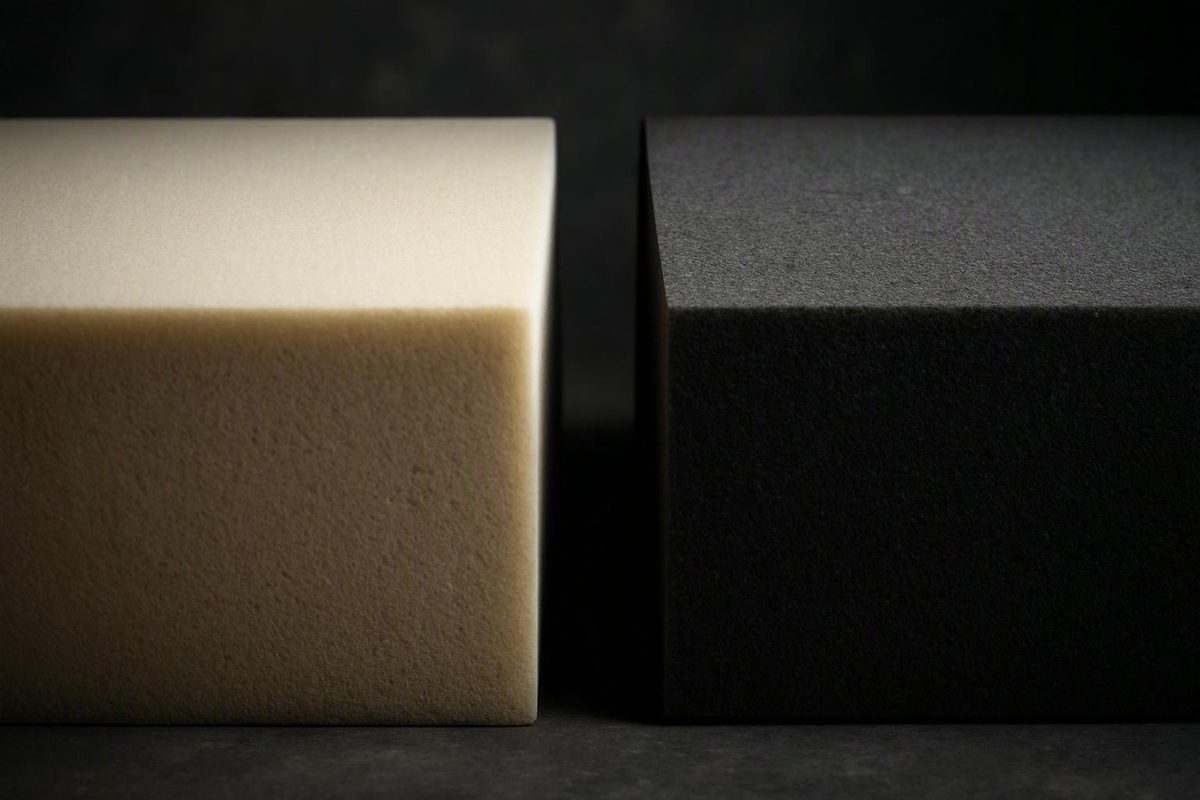
The short answer: often interchangeable on products, not identical in every context
In most product conversations, the practical answer to polyurethane vs urethane is that the labels often refer to the same general material family. Suppliers commonly shorten polyurethane to urethane when describing coatings, wood finishes, elastomers, rollers, wheels, seals, gaskets, and molded components. One industrial manufacturer explicitly treats the terms as interchangeable in those markets while distinguishing that usage from the underlying chemistry. Gallagher’s explanation of industrial polyurethane terminology documents that context-specific convention.
Commercial interchangeability does not make urethane and polyurethane universal chemical synonyms. Depending on context, urethane may refer to:
- A urethane linkage within a molecular structure.
- Commercial shorthand for polyurethane, especially on product labels.
- Ethyl carbamate, a separate organic compound historically called urethane.
The correct interpretation therefore depends on where the word appears. A “urethane floor finish” or “urethane roller” commonly belongs to the polyurethane product family. A chemistry document or regulatory reference may use urethane in a narrower sense.
| Term | Meaning | Common context | Interchangeable with polyurethane? |
|---|---|---|---|
| Urethane linkage | A structural group commonly represented as –NH–COO– | Polymer chemistry and formulation descriptions | No. It is a linkage within a larger molecular structure, not the entire polymer class. |
| Polyurethane | A broad class of polymers containing multiple urethane linkages | Coatings, foams, adhesives, sealants, elastomers, insulation, cushioning, and molded parts | This is the full polymer-family name. |
| Urethane as market shorthand | An abbreviated product or trade name for polyurethane | Coatings, wood finishes, elastomers, wheels, rollers, seals, and molded components | Often, when the manufacturer is using it as shorthand. |
| Urethane meaning ethyl carbamate | A distinct organic compound with the formula C3H7NO2 | Chemical and regulatory discussions | No. Ethyl carbamate is not another name for the polyurethane polymer class. |
The structural representation and market distinction above are described in a commercial chemical-sourcing overview; the formula and ethyl-carbamate distinction are reported in a retailer-authored regulatory guide. Both are secondary commercial sources rather than primary chemistry references, so this article keeps the chemistry at a high level and does not use it to infer product performance. Elchemy’s overview identifies the urethane linkage and polyurethane family, while the separate ethyl-carbamate meaning is addressed later.
A product labeled urethane is not inherently softer, harder, more flexible, faster-curing, cheaper, simpler, or less durable than one labeled polyurethane. Either name may appear on products with substantially different formulations and intended uses.
The useful comparison is between the actual products: their applications, substrates, curing systems, stated properties, test results, installation requirements, and service conditions. For architects, contractors, finishers, and buyers, the front-label term should be treated as an introduction—not a specification.
The chemistry behind the names
A urethane linkage is a structural group commonly represented as –NH–COO–. Polyurethane is a class of polymers containing multiple such linkages. The prefix poly- points to the repeated structural relationship, but polyurethane should not be explained simply as a chain assembled from standalone “urethane monomers.” That shorthand is easy to understand but chemically imprecise.
At a high level, polyurethane production generally involves reactions between compounds containing isocyanate groups and polyols. Those reactions create urethane linkages within a larger polymer structure. Commercial formulations may also contain catalysts, surfactants, and other additives.
The important word is class. Polyurethane is not one material with a fixed recipe or a single predictable set of properties. Products within the family include hard and flexible materials, cellular foams and dense elastomers, clear and pigmented coatings, cushioning products, and load-bearing components.
The presence of urethane linkages alone does not tell a specifier whether a finished product will be:
- hard or soft;
- rigid or flexible;
- clear, amber, opaque, matte, or glossy;
- resistant to a particular chemical or wear condition;
- compatible with a given substrate;
- appropriate for a particular load or movement;
- suitable for interior or exterior exposure;
- ready for service on a particular schedule.
Those characteristics depend on the product formulation and its intended use. Additives, curing chemistry, film build or density, manufacturing method, installation, and service conditions may all be questions to resolve through product-specific documentation and manufacturer consultation.
This distinction becomes especially important when moving between markets. A polyurethane cushioning foam and a polyurethane elastomer used for an industrial wheel belong to the same broad family, but they are not substitutes. Likewise, a polyurethane coating is not merely a thin version of every molded polyurethane part.
The chemistry explains the family name. It does not replace the technical data needed to understand an individual member of that family.
Why manufacturers use both names
Manufacturers use urethane and polyurethane partly because trade vocabulary develops differently across industries. Once a shorter term becomes familiar to applicators, fabricators, distributors, or buyers, it may remain in use even when the longer term would be more chemically explicit.
The pattern is common in coatings and wood finishing. A supplier may call one product a urethane coating, another a polyurethane finish, and a third a urethane-reinforced varnish. Some of these names may describe products in the same broad polyurethane family, but the wording alone does not establish that their resin composition or curing systems are identical.
Coating vendors may also use both terms because customers search for both. A contractor’s discussion says suppliers may use the words interchangeably or favor one for marketing and search visibility. That source is useful as evidence of commercial vocabulary, but its broader performance claims should not be generalized to every coating. Performance Painting discusses the overlap in coating-market terminology.
Wood coatings offer a concrete example. A can described as a “urethane coating” may be sold within the polyurethane-coating category. The name does not tell the finisher whether the product is:
- one-component or two-component;
- waterborne or solventborne;
- clear or pigmented;
- intended for floors, cabinetry, furniture, or millwork;
- compatible with a particular substrate or existing finish.
Those details must be confirmed in the technical data sheet and application instructions.
The same naming overlap appears with molded components. Rollers, wheels, seals, gaskets, bumpers, pads, and custom parts may be sold as either urethane or polyurethane products. In that context, urethane often functions as the compact trade name rather than a separate material category.
Several forces preserve both names:
-
Established trade language: Buyers continue using the vocabulary familiar in their market.
-
Search behavior: Suppliers want products to be discoverable under either term.
- Market convention: Different industries developed different preferences.
- Manufacturer preference: Comparable product families may be named differently by different companies.
- Product positioning: Marketing teams may select the term most familiar to their intended customers.
None of these conventions proves a chemical or performance difference. Conversely, one manufacturer’s use of both words does not prove that two of its products are identical. If products appear different, locate the difference in their formulation, curing system, stated properties, test results, or intended service—not merely in their names.
One polymer family, many very different building products
Polyurethane appears across architecture, construction, interiors, manufacturing, and facilities work because the family can be formulated into many material forms:
- Coatings: Protective or decorative films for approved wood, floor, metal, and other substrates.
-
Flexible foams: Cushioning for furniture, mattresses, seating, and related products.
-
Adhesives: Products intended to bond specified materials under defined preparation and curing conditions.
- Sealants: Flexible joint or gap-filling products for stated service conditions.
- Elastomers: Resilient solid materials used where controlled deformation and recovery are required.
-
Cushioning: Comfort-oriented or energy-absorbing products.
-
Molded components: Wheels, rollers, seals, gaskets, pads, bumpers, and custom shapes.
These categories share a family name, not a universal performance profile. Polyurethane formulations can be engineered for different combinations of hardness, flexibility, impact behavior, abrasion resistance, chemical resistance, and load capacity. These are configurable properties, not guaranteed benefits of every product bearing the polyurethane name.
Consider six products that might all be called polyurethane:
- A floor coating must form a continuous film and satisfy project requirements for adhesion, appearance, traffic, cure, maintenance, and exposure.
- An insulation foam depends on cellular structure, installation, continuity, substrate, and its place in the building assembly.
- A sealant must suit the joint configuration, movement, backing, preparation, and approved adjoining surfaces.
- A furniture cushion is selected primarily for comfort, resilience, and its intended seating application.
- A gasket must fit a defined geometry and function under stated compression and operating conditions.
- An industrial wheel may require specified hardness, load capacity, abrasion behavior, bond, and dimensional tolerance.
Comparing these products by the word polyurethane alone would be like comparing every product called steel without identifying its form, dimensions, treatment, or intended use.
Even products within one category may differ substantially. A coating must be compatible with its substrate and any primer or existing finish. An adhesive must suit both materials being joined. A sealant must accommodate the specified joint. A molded component must fit the required load, geometry, tolerances, and operating environment.
Cast molding and injection molding are both reported methods for producing polyurethane components. That does not make the processes interchangeable or establish which is appropriate for an unnamed part. Process selection should be resolved with the producer based on the formulation, part requirements, production needs, and documented quality criteria. Gallagher’s manufacturing overview provides examples of the family’s engineered properties and molding methods, but it is a manufacturer’s commercial account rather than an independent process standard.
The broad application range demonstrates versatility at the family level. It does not establish that any particular polyurethane formulation is suitable for every building condition.
For coatings, compare the curing system before the name
For coating selection, the most useful first distinction is often not urethane versus polyurethane. It is the actual coating system.
Polyurethane coatings may be:
- one-component or two-component;
- waterborne or solventborne;
- clear or pigmented;
- available in different sheens;
- designed for different substrates and service conditions.
A one-component, or 1K, coating is supplied without a separately mixed hardener. Depending on its chemistry, it cures through the mechanism stated by the manufacturer. Its principal practical advantage is convenience: the applicator does not have to proportion and mix a separate hardener before use.
A two-component, or 2K, coating is supplied as a base and separate hardener. Once mixed, the material generally has a limited working period, commonly called pot life. That period must be taken from the current product data rather than assumed.
Supplier guidance for wood coatings describes 1K products as easier and generally less costly to apply. It describes 2K products as more demanding because they require accurate mixing and application control, while noting that they may offer faster curing and greater chemical and mechanical resistance. These are supplier-described category tendencies—not guarantees for every formulation. Gemini Wood Finishes compares 1K and 2K polyurethane wood coatings.
Typical 1K considerations
- No separate hardener to measure or mix.
-
Simpler setup for small jobs or intermittent use.
-
Potentially slower curing or lower resistance than a particular 2K alternative.
- Performance still depends on preparation, film build, application conditions, and compliance with instructions.
Typical 2K considerations
- Base and hardener must be mixed accurately.
- Planning must account for any specified induction time, pot life, crew pace, and equipment cleanup.
- Incorrect proportioning or incomplete mixing can compromise the result.
- A selected product may offer faster curing or greater chemical and mechanical resistance than a selected 1K product.
- Added complexity, cost, or scheduling constraints may be unnecessary for modest exposure.
2K is not always better. Greater resistance matters only if the project needs it, the product documents demonstrate it, and the applicator can reliably control mixing and installation. A convenient 1K product may be the better choice when it satisfies the actual acceptance criteria.
The same caution applies to waterborne versus solventborne polyurethane. These are broad categories, not automatic rankings. The available evidence does not establish either as universally more durable, safer, easier to apply, clearer, faster, or environmentally preferable. Compare the actual products and the governing project requirements.
For wood finishes, appearance should also be separated from terminology. The result may be affected by:
- overall formulation;
- clear or pigmented design;
- film thickness;
- sheen;
- substrate color and porosity;
- sanding and preparation;
- application method;
- drying conditions;
- application quality.
Two products labeled polyurethane can look different. Products labeled urethane and polyurethane may look similar when their formulations and application methods are comparable. A sample or approved mock-up on the representative substrate, at the intended sheen and film build, is more informative than a naming debate.
Comparisons with epoxy or conventional varnish require equal discipline. A statement such as “polyurethane is tougher” is incomplete unless it identifies the products, substrate, preparation, exposure, measured property, and acceptance threshold. Category names cannot settle a project-specific comparison.
A specification checklist for comparing actual products
A useful specification translates broad expectations into verifiable requirements. Begin with the product type and intended service, then compare candidates on a like-for-like basis.
Core criteria for any polyurethane product
- Intended substrate and use: Is the product approved for the material or assembly involved?
- Product form: Is it a coating, foam, adhesive, sealant, elastomer, insulation product, cushion, or molded component?
- Hardness: Is the stated hardness relevant to the product’s function?
- Flexibility: Must the material bend, elongate, compress, recover, or accommodate movement?
- Abrasion resistance: What wear mechanism is expected, and is product-specific evidence available?
- Chemical resistance: Which chemicals, concentrations, contact periods, and service conditions matter?
- Operating-temperature range: Does the manufacturer state a range applicable to the proposed use?
- Load capacity: What static or dynamic loads apply to wheels, rollers, pads, or other components?
- Impact requirements: Is the concern repeated impact, isolated shock, or energy absorption?
- Geometry and dimensions: What tolerances, thicknesses, edges, and attachment details control performance?
- Environmental exposure: Will the product encounter water, humidity, sunlight, weather, or specified cleaning agents?
A generic statement such as “highly abrasion resistant” is not enough by itself. Look for a result, test description, comparison basis, and acceptance criterion relevant to the proposed use.
Additional criteria for coatings
For coatings, review:
- solids content;
- viscosity;
- stated VOC level;
- available sheen;
- cure time under stated conditions;
- recoat window;
- hardness;
- recommended wet and dry film build;
- substrate compatibility;
- primer requirements;
- abrasion and chemical-resistance data;
- application method;
- appearance and color information.
Gemini’s wood-coating guidance recommends comparing solids, viscosity, VOC level, sheen, cure time, recoat window, hardness, and resistance properties rather than relying on the polyurethane name. Because that guidance addresses wood coatings, its checklist should be adapted rather than automatically transferred to every coating application.
Curing-system details
Confirm:
- whether the coating is 1K or 2K;
- the mixing ratio, if applicable;
- whether proportioning is by volume, weight, or another stated method;
- required mixing procedure;
- induction time, if any;
- pot life under the stated conditions;
- allowable substrate and ambient conditions;
- preparation requirements;
- application-equipment requirements;
- recoat and return-to-service conditions.
These requirements affect labor, sequencing, waste, and quality control. Suitability must be evaluated from the relevant product documents rather than assumed from the family name.
Product-specific evidence
For every reported result, ask:
- Is it for the exact product being specified or only for a broader family?
- Was it obtained at the proposed film thickness, density, hardness, or configuration?
- Are the substrate and preparation comparable to the project?
- Are conditioning and exposure conditions stated?
- Is the result typical, minimum, maximum, or warranted?
- Are competing products evaluated on the same basis?
- Does the project require separate acceptance testing?
The objective is not to collect the most favorable claims. It is to find evidence corresponding to the project’s likely failure modes and acceptance requirements.
A short document-review sequence
- Identify the product type. Establish whether it is a coating, foam, adhesive, sealant, elastomer, insulation product, cushion, or molded component.
- Read the technical data sheet. Verify intended use, compatible substrates, stated properties, limitations, and application conditions.
- Confirm the curing system. Identify component count, mixing requirements, pot life, cure conditions, and recoat constraints.
-
Review stated test results. Match the reported properties and conditions to the project criteria.
-
Compare documents for consistency. Confirm that the label, technical data sheet, safety data sheet, and instructions concern the same product and revision.
- Resolve discrepancies. Obtain written manufacturer clarification where names, limits, preparation steps, or reported properties conflict.
Do not fill documentary gaps with assumptions about polyurethane as a family. If the technical data does not establish suitability for the intended substrate or exposure, the front label cannot supply the missing evidence.
The separate meaning of urethane: ethyl carbamate
In a different chemical context, urethane can mean ethyl carbamate, a distinct organic compound with the molecular formula C3H7NO2. Ethyl carbamate is not another name for polyurethane, and a finished polyurethane product is not simply a collection of ethyl carbamate molecules. A retailer-authored guide makes this distinction while discussing California Proposition 65. The Monos guide identifies urethane as ethyl carbamate and distinguishes it from polyurethane.
Context resolves most of the ambiguity:
- A urethane floor finish commonly refers to a polyurethane-family coating.
- A molded urethane wheel commonly refers to a polyurethane elastomer.
- A reference to a urethane linkage concerns the –NH–COO– structural group.
- A chemical or regulatory reference to urethane as a named substance may mean ethyl carbamate.
The Monos guide reports that urethane, meaning ethyl carbamate, is listed under California Proposition 65 and distinguishes that compound from finished polyurethane. However, the guide is a commercial secondary source, not an official regulatory record. Its account should not be treated as independent verification of current listing status, warning requirements, exposure thresholds, or any product’s compliance.
A Proposition 65 warning on a polyurethane-containing product does not, by itself:
- identify polyurethane as the listed substance;
-
prove that ethyl carbamate is present;
-
determine that the product is safe or unsafe for the proposed use.
Read the exact warning rather than attempting to infer its meaning from the material name. Identify the named chemical and exposure route, if stated. Then review current manufacturer disclosures and the official regulatory information applicable to that substance and jurisdiction.
Material safety also cannot be reduced to the cured article’s family name. Use the current safety data sheet and manufacturer instructions for the exact product and task. Do not transfer precautions from an unrelated polyurethane formulation.
The terminology lesson is narrow but important: urethane can mean market shorthand in one document and a specific compound in another. The surrounding context and exact named chemical control the interpretation.
A decision workflow for architects, contractors, and buyers
When the product names do not settle the issue, use a workflow that begins with the application and ends with documentary verification.
1. Classify the application
Determine what is being selected:
- coating;
- flexible or rigid foam;
- adhesive;
- sealant;
- elastomer;
- insulation;
- cushioning;
- molded component.
This prevents irrelevant comparisons. Coating criteria should not be applied wholesale to a gasket, and foam properties should not be used to infer the performance of a wheel.
2. Define the service conditions
Describe what the material must encounter and accomplish. Depending on the application, this may include:
- substrate or adjoining materials;
- pedestrian, rolling, or vehicle traffic;
- static or dynamic load;
- impact and abrasion;
- chemical exposure;
- water or humidity;
- desired appearance and sheen;
- joint or component movement;
- cleaning and maintenance;
- geometry and tolerances;
- manufacturer-stated environmental limits;
- installation access and schedule.
Replace vague requirements such as “heavy duty” with defined conditions and acceptance criteria wherever possible.
3. Identify the formulation and system
Use the technical documentation to determine what the manufacturer means by urethane or polyurethane. Establish the product type, component count, curing mechanism, intended substrate, and stated limitations.
Do not assume a urethane-labeled product belongs to a separate performance tier. Conversely, do not assume two polyurethane-labeled products are comparable simply because they share a family name.
4. For coatings, compare product by product
Determine whether each coating is:
- 1K or 2K;
- waterborne or solventborne;
- clear or pigmented;
- compatible with the substrate and existing finish;
- intended for the expected traffic and exposure;
- feasible under project application conditions.
Then compare mixing demands, pot life, cure conditions, recoat windows, film build, sheen, preparation, and stated resistance. A 2K product may offer useful performance but create unacceptable mixing, shutdown, or waste constraints. A 1K product may be operationally preferable if it satisfies the project requirements.
5. For molded components, define mechanical and production needs
For a roller, wheel, seal, gasket, pad, or custom part, compare:
- hardness;
- flexibility or recovery;
- abrasion requirements;
- chemical exposure;
- manufacturer-stated operating conditions;
- static and dynamic loads;
- impact;
- geometry and tolerances;
- bond or attachment requirements;
- production quantity;
- documented performance.
Discuss the manufacturing process with the producer. The evidence establishes that cast and injection molding are used for polyurethane components, but it does not support a universal rule for choosing between them.
6. Demand defined comparisons with alternatives
Claims that polyurethane outperforms epoxy, rubber, plastic, metal, or conventional varnish are incomplete unless the comparison identifies:
- exact products or grades;
- relevant dimensions or film builds;
- substrate and preparation;
- exposure conditions;
- test procedure;
- measured property;
- acceptance threshold;
- maintenance expectations.
A polyurethane product may compare favorably with one alternative for a defined property and be less suitable for another requirement. Broad superiority language is not a project-specific comparison.
7. Reconcile the documents
Before approving, buying, or applying the product, verify agreement among:
- the label and exact product identifier;
- technical data sheet;
- safety data sheet;
- test reports or stated results;
- installation instructions;
- project specification;
- manufacturer’s written clarification.
Confirm that the documents apply to the same formulation and current revision. Resolve conflicting mix ratios, cure times, preparation requirements, environmental limits, or substrate statements before work begins.
This workflow has an important evidence limit: it explains terminology and provides a selection process, but it cannot establish the suitability of an unnamed formulation. Polyurethane identifies a broad family. Urethane often identifies that same family in market language. Neither word can replace product-specific evidence.
Frequently asked questions
Is urethane just a shorter name for polyurethane?
Often, yes—but only in a product-market context.
Coating, wood-finish, elastomer, and molded-component suppliers frequently use urethane as shorthand for polyurethane. The shorter term does not inherently indicate different hardness, flexibility, durability, or curing behavior.
In chemistry or regulatory writing, urethane may instead refer to a structural linkage or to ethyl carbamate. Determine the intended meaning from the context and supporting documentation.
Is a urethane coating different from a polyurethane coating?
Not necessarily. In many coating markets, urethane coating is a shortened commercial name for a polyurethane coating.
Two products carrying those labels may still differ substantially in formulation, component count, curing system, carrier, solids, film build, sheen, substrate compatibility, and intended exposure. Compare the technical data sheets rather than treating the names as separate performance categories.
Is 2K polyurethane always better than 1K polyurethane?
No. A 2K coating requires a base and hardener to be mixed before application. Supplier guidance indicates that 2K systems may provide faster curing and greater chemical or mechanical resistance, but they also require accurate mixing and have a limited working period after mixing.
A 1K product may be preferable when ease of use, small work areas, intermittent application, lower complexity, or reduced mixed-material waste matters—provided its documented performance meets the project requirements.
Why might a polyurethane-containing product carry a Proposition 65 warning?
The warning may concern a listed chemical associated with the particular product rather than establishing that polyurethane, as a broad polymer family, is the named substance.
Do not infer the chemical, exposure route, or level of risk from the word polyurethane. Read the exact warning, review current manufacturer disclosures, and consult current official regulatory information for the named substance. The commercial evidence available for this article is not a substitute for an official determination.
What documents should I check before specifying a urethane or polyurethane product?
At minimum, review:
- The label and exact product identifier.
- The current technical data sheet.
- The current safety data sheet.
- Application or installation instructions.
- Product-specific test results relevant to the intended use.
- Substrate-preparation and compatibility requirements.
- Mixing ratio, pot life, cure conditions, and recoat limits where applicable.
- Written manufacturer clarification for discrepancies.
The practical rule is straightforward: in most product conversations, urethane is likely shorthand for polyurethane, but the name alone cannot establish chemistry, performance, or safety. Identify the application, determine what the manufacturer means, and compare the formulation, curing system, technical data, test results, safety information, and installation requirements before specifying or buying.