
Polyiso R-Value: Read the Thickness, Temperature and Assembly
Compare polyiso R-values by thickness, understand aged and LTTR ratings, and account for temperature and thermal bridges in wall and roof design.
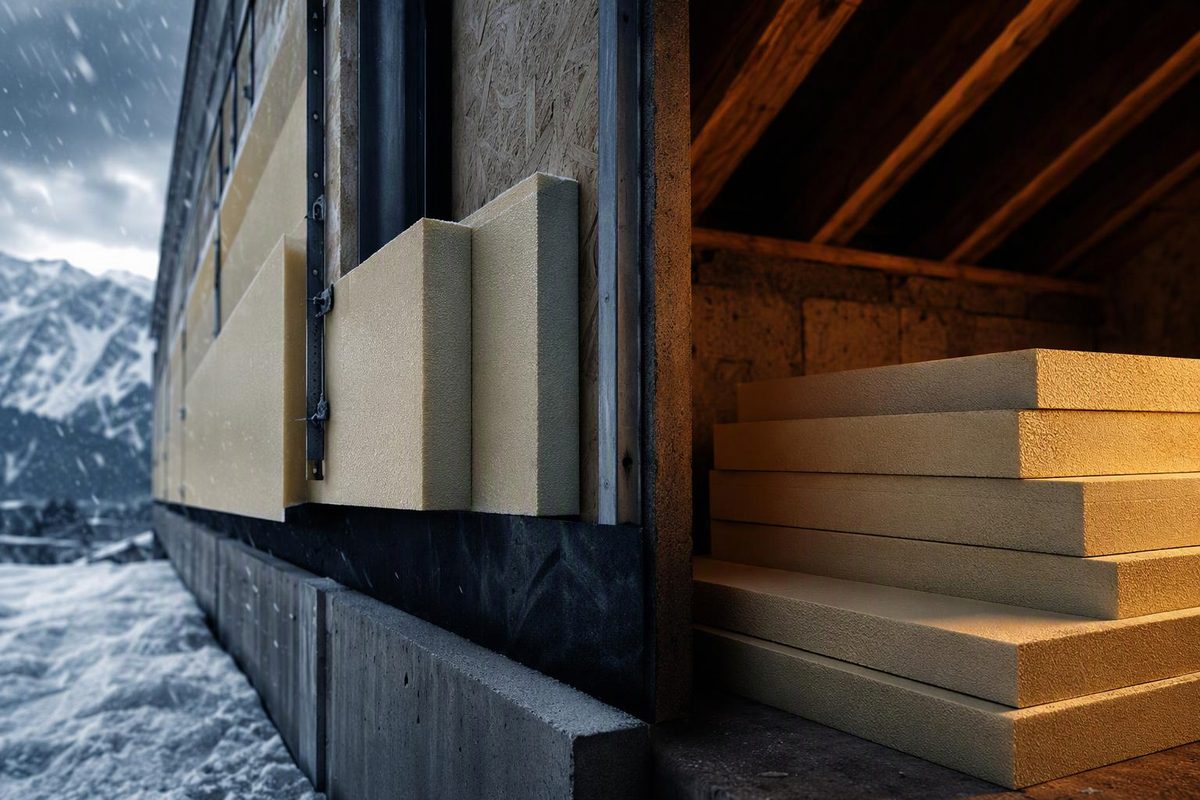
Polyiso—rigid polyisocyanurate foam insulation—has no single universal R-value per inch. For a 1-inch board, published examples include R-5.7 for glass-reinforced-facer roof insulation and R-6.0 for foil-faced wall insulation. At 2 inches, those same products are rated R-11.4 and R-13, respectively. The useful number is the manufacturer’s rating for the exact product and thickness—not a blanket “R-6 per inch.” (Roof product data; wall product data)
That board rating does not necessarily equal its thermal resistance under winter operating conditions, or the effective R-value of the finished wall or roof.
R-value by thickness: two product examples
The table compares Johns Manville AP Foil-Faced continuous insulation, with foil on both faces, and ENRGY 3 roof insulation, with glass-reinforced facers. These are product-specific reference values, not interchangeable specifications.
| Board thickness | AP Foil-Faced: aged R-value | ENRGY 3: LTTR |
|---|---|---|
| 1 inch | R-6.0 | R-5.7 |
| 1½ inches | R-9.3 | R-8.6 |
| 2 inches | R-13 | R-11.4 |
| 2½ inches | R-16 | R-14.4 |
| 3 inches | R-19 | R-17.4 |
| 4 inches | R-26 | R-23.6 |
Sources: AP Foil-Faced data sheet, November 2025, and ENRGY 3 data sheet, March 2026. Both report U.S. R-values (h·ft²·°F/Btu) at 75°F; the AP column excludes reflective air-space resistance.
Do not multiply the 1-inch rating to select every thicker board. For example, four times ENRGY 3’s R-5.7 is R-22.8, while its published 4-inch rating is R-23.6.
Conversely, calculate a multilayer installation from each layer’s rating, rather than using the rating for a single board of the combined thickness. Building Science Corporation’s multilayer testing discussion illustrates this distinction. Using the ENRGY 3 table above, two 2-inch boards provide a nominal insulation-layer total of R-22.8—not the R-23.6 listed for one 4-inch board. Two 2.6-inch boards, each listed at R-15, provide nominal R-30 at 5.2 inches total thickness. That is an insulation-layer calculation, not a whole-roof rating.
What “aged R-value” and “LTTR” mean
Polyiso’s closed cells initially contain insulating gases from manufacturing. Over time, some gases diffuse out and air replaces them, reducing thermal resistance. Aging procedures account for that change rather than reporting only the performance of freshly manufactured foam. (Building Science Corporation)
The AP sheet reports an aged value under ASTM C1289, using accelerated conditioning of 90 days at 140°F. ENRGY 3 reports long-term thermal resistance, or LTTR, determined under CAN/ULC S770. The industry association PIMA describes LTTR as an estimate of resistance at five years that closely corresponds to the average over a 15-year service life. (PIMA Technical Bulletin 203)
Neither designation promises that resistance remains identical at every temperature. Record the rating method alongside the specified thickness, particularly when comparing wall and roof products or products marketed in different jurisdictions.
Temperature changes the design question
The mean test temperature is the average of the hot- and cold-side temperatures across the specimen, not simply outdoor air temperature. In a test with faces at 50°F and 100°F, the mean is 75°F.
Building Science Corporation’s testing of polyiso roof insulation found significant differences among manufacturers and reduced performance under cold-service conditions and very hot roof conditions. Its mean-temperature results were consistent with NRCA testing. The relationship was nonlinear, so a simple correction based only on mean temperature cannot reliably predict every installation’s performance. These findings concern the tested roof-insulation samples, not every current polyiso product. (BSC roof-insulation study)
In its March 2015 report, NRCA recommended design values of R-5.0 per inch for heating conditions and R-5.6 for cooling conditions, based on its roof-insulation testing. Those are historical roof-design recommendations, not measured values for every current polyiso formulation or foil-faced wall board. (NRCA testing report)
For a cold-climate project, request temperature-dependent data for the proposed product. Evaluate the temperatures across the insulation within the actual roof or wall, rather than treating the outdoor design temperature as the board’s mean temperature. Keep the declared rating used for compliance separate from any in-service value used for performance analysis.
Board R-value is not assembly R-value
Adding insulation-layer ratings does not account for heat flowing through studs, fasteners, cladding supports, shelf angles or other conductive paths. Such bridges can substantially reduce effective assembly resistance. Continuous exterior insulation helps, but attachments and structural interruptions still need attention. (DOE Building America guidance)
On the drawings, carry the insulation through wall-to-roof transitions, opening returns and slab-edge details. Coordinate its thickness with attachment lengths, flashing projections and roof-edge heights. Our guide to continuous insulation and whole-wall design covers those interruptions in more detail.
Two other specification traps matter:
- Foil does not automatically add another R-value. AP’s separate reflective-air-space ratings require the shiny face toward an ideal air space under specified horizontal heat-flow conditions. Do not use those combined ratings where the board is sandwiched against another material.
- A foil-faced board changes drying potential. AP at 1 inch or thicker is listed as a Class I vapor retarder. Its placement therefore needs moisture-control review, not just an R-value check. (AP technical data)
Specify the product and facer, rating basis, individual layer thicknesses and total thickness. Then verify the complete assembly’s thermal performance, moisture strategy and applicable fire protection requirements. A note saying only “polyiso, R-30” leaves too much of the building detail unresolved.