
Specify Fire-Rated Plywood Without Confusing Panels and Assemblies
Learn what FRT plywood labels establish, when an hourly assembly rating is needed, and how treatment affects structural capacity, exposure and installation.
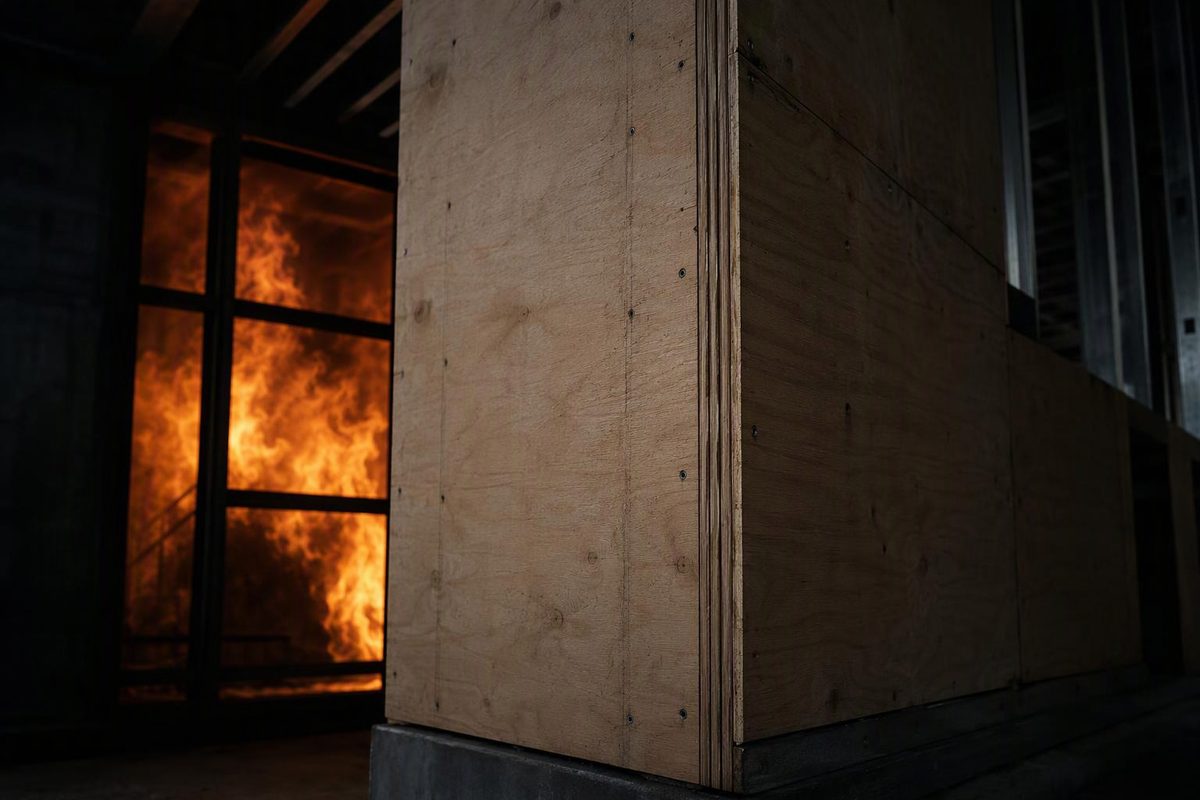
“Fire-rated plywood” usually means fire-retardant-treated (FRT) plywood, chemically impregnated during manufacture to reduce surface flame spread. The sheet itself does not provide a one- or two-hour fire-resistance rating. That rating belongs to a qualifying wall, floor or roof assembly—not simply its plywood layer. APA explains the distinction.
For a U.S. project, specify the actual requirement: FRT material, a surface-burning classification, an hourly fire-resistance-rated assembly, a roof-covering classification, or a combination. Check the locally adopted code and the selected product’s evaluation report before approving a substitution.
Select the required fire performance and exposure; the tool identifies the approval route to check.
Find the Approval Route
Check the FRT Product Approval
Verify factory chemical impregnation and the extended surface-burning requirements in the adopted code. A Class A result alone is insufficient.
Protected and dry does not automatically mean approved: confirm the report covers the assembly and its service conditions.
For structural use, obtain treatment-specific capacity and connection requirements. This check does not certify compliance.
Sources: 2024 IBC §2303.2; APA fire-systems guidance; PyroGuard report §§6.4 and 7.5. Local adoption and product approvals control.
Fire Performance Has Three Separate Approval Routes
| Requirement | Test Basis | What It Establishes |
|---|---|---|
| Surface burning | ASTM E84 or UL 723 | Flame-spread and smoke-developed indices |
| Fire resistance | ASTM E119 or UL 263 | Qualifying assembly’s endurance in hours |
| Roof-covering classification | ASTM E108 or UL 790 | Roof-covering system’s fire performance |
Class A interior finish corresponds to a flame-spread index of 0–25 and a smoke-developed index no greater than 450. Intertek describes these surface-burning classifications. They do not establish an hourly assembly rating or a roof-covering classification.
Class A alone does not establish that plywood qualifies as FRT. The 2024 IBC, Section 2303.2, requires chemical impregnation during manufacture, a listed flame-spread index of 25 or less, an additional 20-minute test period, and flame-front travel no more than 10½ feet beyond the burner centerline at any time. A routine 10-minute ASTM E84 result does not establish all those conditions.
The code edition adopted locally controls the project. A product’s surface-burning result is only one part of determining whether its approval covers the intended use.
Treatment Reduces Flame Spread, Not the Need for an Assembly
When heated, wood decomposes and releases gases that can sustain flaming. Fire-retardant chemicals interrupt that process through mechanisms that can include increased char formation, dilution of flammable gases and reduced heat available to sustain burning. The mechanism depends on the formulation. USDA Forest Products Laboratory research describes these effects.
Treatment does not turn plywood into a stand-alone fire barrier. FRT wood can replace noncombustible materials in certain code-permitted applications, but it is not a universal substitute. Ordinary plywood can also be part of a rated, protected assembly. APA’s fire-rated construction guidance distinguishes these routes and directs designers to the treating company’s structural data.
For an hourly requirement, identify the accepted assembly design and match its layers, supports, joints and fastening. A specification reading only “one-hour plywood” leaves the actual fire-resistance construction undefined.
A Surface Coating Is Not Factory-Treated Structural FRT
According to APA, proprietary paints can reduce plywood’s flame spread for nonstructural interior finishes. That does not establish compliance with a specification for factory-treated structural FRT panels.
A surface-coated product without chemical impregnation does not meet the IBC definition of FRT wood. Approval as an alternative requires appropriate evaluation and code-official acceptance. The American Wood Council explains this distinction.
Do not approve a painted panel merely because its submittal shows a Class A result. Check whether the requirement is an interior-finish classification, structural FRT material, or an assembly rating; the evidence must address that requirement.
Structural Capacity Must Follow the Selected Treatment
Do not substitute FRT plywood sheet-for-sheet using only the untreated panel’s thickness and span stamp. Treatment, redrying and service conditions can affect structural performance. Use the selected treatment’s approved load/span tables and connection requirements.
The consequence can be a thicker panel or revised fastening. For example, the July 2026 Dricon FS report requires 19/32-inch treated plywood where 15/32-inch untreated plywood would satisfy its referenced diaphragm or shear-wall table. This is a product-specific requirement, not a universal thickness rule for FRT plywood. ESR-4584, Section 4.4, gives that requirement; the report also details product identification and structural grade marking.
For roof decking, coordinate framing spacing, loading, panel orientation and edge support before applying treatment-specific limits. The guide to roof plywood thickness explains the underlying panel-selection checks.
Exterior Bonding Does Not Establish Exterior Treatment Suitability
An Exterior plywood bond classification concerns the panel’s ability to withstand moisture exposure. An exterior fire-retardant treatment concerns the treatment’s suitability for weather exposure. One does not establish the other.
APA explains panel bond classifications, while Hoover’s design guide identifies bond classifications and treatment exposure categories separately.
Interior FRT plywood may be used inside a protected exterior-wall assembly, subject to its approval. An interior treatment is not automatically suitable for exposed soffits, recurring condensation or direct wetting.
Assembly restrictions also matter. The PyroGuard evaluation report separately documents surface burning, rated wall assemblies and roof-system testing. Its Sections 6.4 and 7.5 prohibit unvented roofing assemblies, ground contact and applications with permanent exposure to precipitation, direct or indirect wetting, or condensation. These are PyroGuard restrictions; they should not be treated as the approval conditions for every FRT product.
A compliant fire label does not override a product’s exposure or assembly restrictions.
Specify the Panel, Treatment and Assembly Separately
| Specification Item | Required Information |
|---|---|
| Panel | Performance category or thickness, structural grade, product standard and bond classification |
| Treatment | Named treatment or performance-based equivalent, evaluation report, surface-burning requirements and permitted exposure |
| Structural basis | Treatment-specific loads, spans, shear capacities, connection adjustments and service-temperature limits |
| Rated assembly | Accepted design and required layers, supports, joints and fastening |
Require product identification and structural grade marks, then match delivered panels to the approved submittal. Photograph labels before enclosure so the installed product remains traceable.
Follow the selected report for fastener metals, storage, drying and field modifications. PyroGuard, for example, permits its plywood to be field-cut or ripped in any direction but prohibits field milling or ripping of its treated lumber. Permission to cut—and any required cut treatment—must come from the actual product instructions, not assumptions about pressure-treated wood generally.